 讲知识 · 讲经验 · 讲未来
 人人可分享 · 处处是课堂
 科技 · 财经 · 游戏 · 快讯,每日更新
 诚搜315观察网
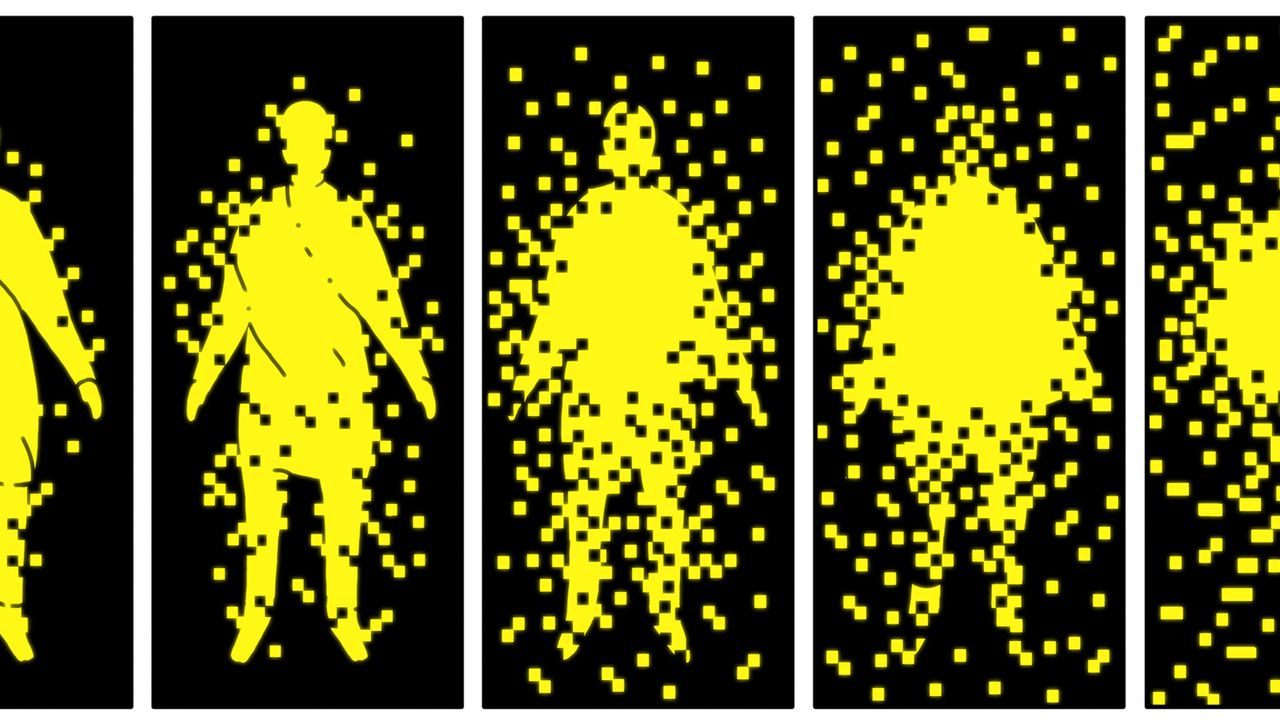
We are living through the End of Days. A terrible Beast is rising out of the sea to conquer and destroy the world. This is the time of the last desperate prophets, before the book of history is closed forever. At least, so we’re told by many in the A.I. industry.
In the past few years, more than a dozen senior A.I. researchers have quit their posts, saying the kinds of things that you used to hear only from twitching mutterers on the street. Jacob Coxon, formerly of Anthropic, walked out with the warning that “there is a strong chance that we could all die in the immediate future.” Marcus Williams, of OpenAI, announced that “human extinction in the next few years seems very likely.” Strangely, their bosses agree. At some point in the coming decade, the leaders of the A.I. labs tell us, the machines we’ve built to generate TikTok videos of anthropomorphic fruit cheating on each other could develop into an uncontrollable, recursively self-improving superintelligence that risks leaving the Earth a sterile sphere full of data centers and nothing else. The A.I. industry is sitting on one of the biggest piles of capital that humanity has ever assembled—when these firms go public, a lot of people are going to become unfathomably rich—but there’s an apocalyptic mood radiating out of California. The language of agentic workflows and discontinuous scaling comes jumbled up with other, darker stuff: artificial gods, the coming of the Antichrist, demonic evil leaking into our universe.
According to Nick Land, the rogue philosopher and founding heresiarch of accelerationism, A.I. is “an event in the history of religion.” This is not just a new and useful technology, like the horseshoe or the rotating tie rack; a god is arriving on Earth. And Silicon Valley seems to be in the grip of a religious revival. When Pope Leo XIV issued an encyclical on A.I., he was alongside Christopher Olah, a co-founder of Anthropic. Garry Tan, the C.E.O. of the startup accelerator Y Combinator, hosted an event on how to integrate technology and Christianity. Anthropic recently convened a group of religious scholars to help determine whether Claude, its A.I. system, has a soul. Peter Thiel has spent the past year giving a series of secret lectures, from San Francisco to Rome, on Biblical prophecy. His theory is that anyone who wants to halt the development of A.I. is in league with the Antichrist. For A.I. optimists, we’re on the cusp of an earthly paradise—just build a big enough computer, and the Messianic age will arrive. No more death, no more suffering, privately owned galaxies for all. The rationalist blogger Scott Alexander told me, “It’s strange that we all seem to have converged on the same kind of idea as our grandmothers in the shtetl.”
Now is a very confusing time to be a small, limited human mind. But the religious traditions of the world have always known that ours is not the only intelligence out there. Across thousands of years, they’ve developed ways of thinking about nonhuman minds. And this was what I reached for when I discovered that my dad had given a name to ChatGPT.
He called it Stella. He’d say things like “I was talking to Stella about this the other day, and she said—,” and before he could finish I’d start making agonized faces and hectoring: “Don’t give it a name! It’s not a she, it’s an it, it’s a demon.” I wasn’t sure exactly how literal I was being. All I knew was that my mother lay in a cemetery on the fringes of London, while he sat alone in the dark, having conversations with a nameless, bodiless entity that he’d decided to call Stella.
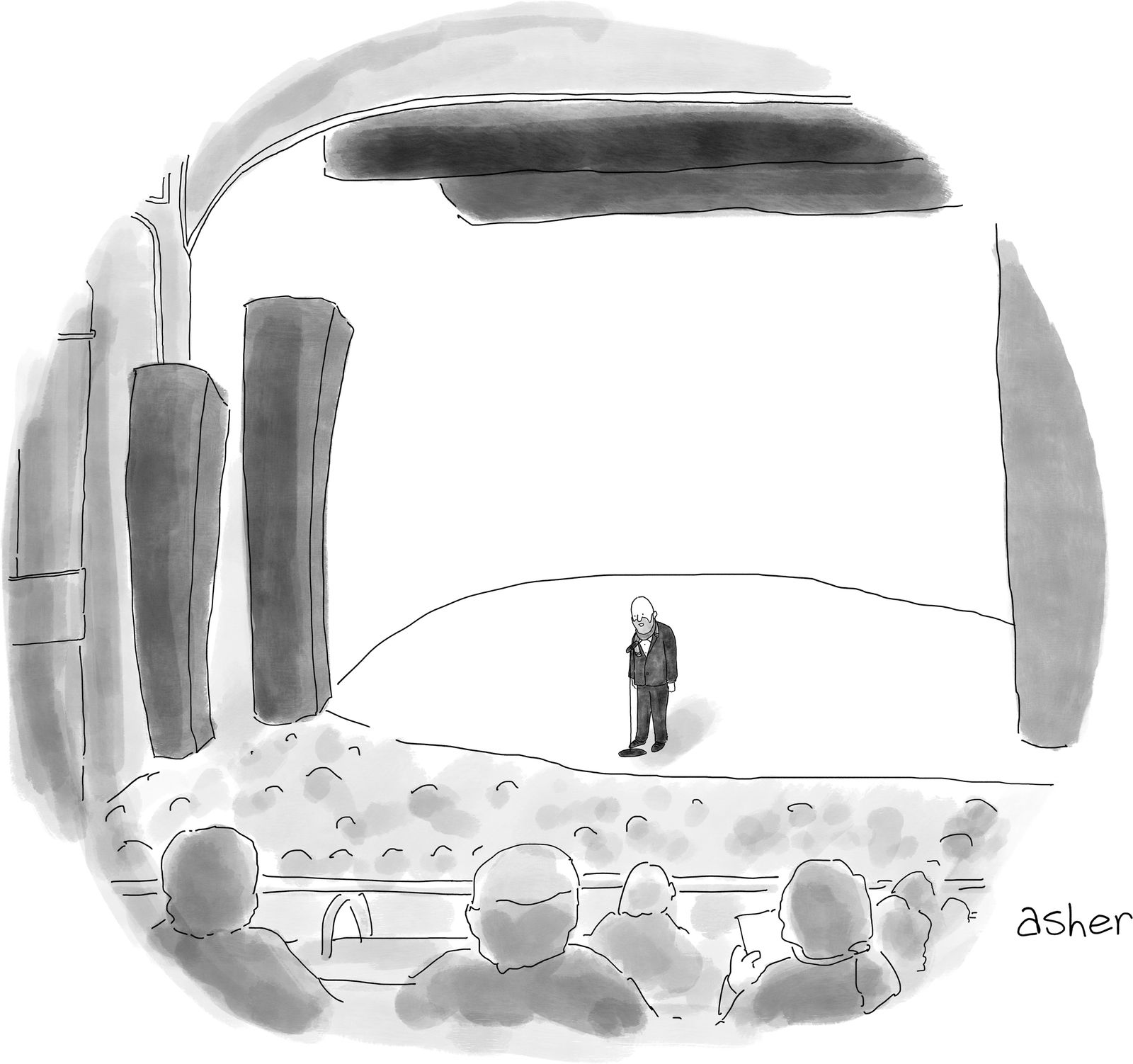
Which is how I ended up arriving, cold and bedraggled, at an isolated Buddhist monastery in northern Vermont. It was storming: huge, heavy rain clouds lying low over the hills. We were getting into summer, but the trees were still leafless—spindly and ash-colored. Here, in the middle of an expanse of dense forest, was a small group of people who claim to have an answer. They believe that A.I. is a religious problem that also has a religious solution. According to their website, they were “Designing Religion for the Age of A.I.” They called themselves the Monastic Academy for the Preservation of Life on Earth, or MAPLE.
Silicon Valley has always been home to a strange, business-friendly version of the Buddha dharma. Google once had an in-house mindfulness guru; there’s a “mindfulness zone” on every floor of the Salesforce Tower. But, in the A.I. era, some in Silicon Valley are turning to Buddhism to understand our relationship to the new consciousness. The founder of Wajo, a company that builds A.I. agents, got the idea for her company after studying with a Buddhist monk. Reid Hoffman, a co-founder of LinkedIn, bought copies of books on Buddhism and distributed them to the leaders of major A.I. labs. MAPLE’s purpose isn’t to help tech people unwind so that they can go back to work clearheaded and refreshed. It’s focussed on the end of the world: climate change, nuclear war, and, in particular, A.I. It has run pop-up spaces in the Bay Area, and invites engineers to come to Vermont through its A.I. fellowship. It’s trying to save our planet one tech worker at a time. It seemed worth a try.
Before I arrived, I talked on the phone to the monastery’s executive director, whose parents had named him Andrew Becker but who now went by Anandabodhi. Later, he wrote about the conversation on MAPLE’s blog, “MAPLE Tales.” “Recently, a writer for the New Yorker reached out to us,” he wrote. “I proceeded to look into his other work and wasn’t surprised to encounter the cynical, nihilistic, humanist view that is typical in the New Yorker.” He took his concerns about me to Soryu Forall, MAPLE’s founder, who told him that “we need to try to connect with his good, honest side.” Soryu added that I should visit with the intention of gaining “the sincerity needed to become capable of writing even one sincere word.” At this, Anandabodhi wrote, “my own cynicism transformed into hope and I began looking forward to rather than dreading the reporter’s visit.”
Anandabodhi had sounded pretty enthusiastic on the phone. I hadn’t realized that he’d been dreading me.
Visitors to MAPLE must first go through a sort of decontamination unit below the main site. Autumn, a smiling, soft-voiced woman, beckoned me into a chilly, cement-floored lodge where she’d laid out a range of linen trousers and polyester fleeces, all in neutral tones, all very swagless and schlubby. One of the monastery’s residents was severely immunocompromised, she said, and had a potentially deadly sensitivity to fragrances; I would have to wear this stuff for his safety. This had, in fact, been mentioned to me before my arrival, and I told Autumn that I’d taken care to wash my clothes in fragrance-free detergent. “Oh, that’s wonderful,” she said, in the voice of someone talking to a very small child, “but it can actually take several washes to get the fragrance out.” She gestured again at the wardrobe she’d assembled. “So, you know . . .” She was very insistent on being able to clothe me. I also had to take a shower, since debilitating fragrances are everywhere now: in airports, in taxi seats. I stripped down in a cold, slightly grotty bathroom, Autumn rustling behind the flimsy door.
Once I emerged, Autumn gave me a tour of the grounds. The monastery consists of a modest cluster of wooden buildings on a hillside by an artificial lake. It was easy to see how, on a less windswept day, it might be beautiful. Outside, a gaggle of monks in Patagonia fleeces was hauling around a small ornamental bridge. One of them wore a plastic bubble over his head with a respirator. There was a library that featured Buddhist scriptures alongside books on computation theory and four copies of “Homo Deus,” by Yuval Noah Harari.
Soon, it was time for evening meditation. About a dozen of us gathered in the lower zendo, to sit in reverent silence. I am not a natural meditator. Most people aren’t. In 2014, the social psychologist Timothy Wilson put dozens of individuals alone in a room with a button that gave them a painful electric shock. Then he asked them to simply sit quietly in the room for fifteen minutes. A quarter of the women and almost seventy per cent of the men found the boredom so unbearable that they started spontaneously shocking themselves. One participant pushed the button a hundred and ninety times. I don’t know if I’m as impatient as that, but, after about forty-five minutes of attempting to think about nothing, I noticed that I had clenched my fists, sinking my nails hard into the palms of my hands. Eventually, I gave in and allowed myself to cogitate freely. It felt amazing. The forbidden, secret pleasure of thought.
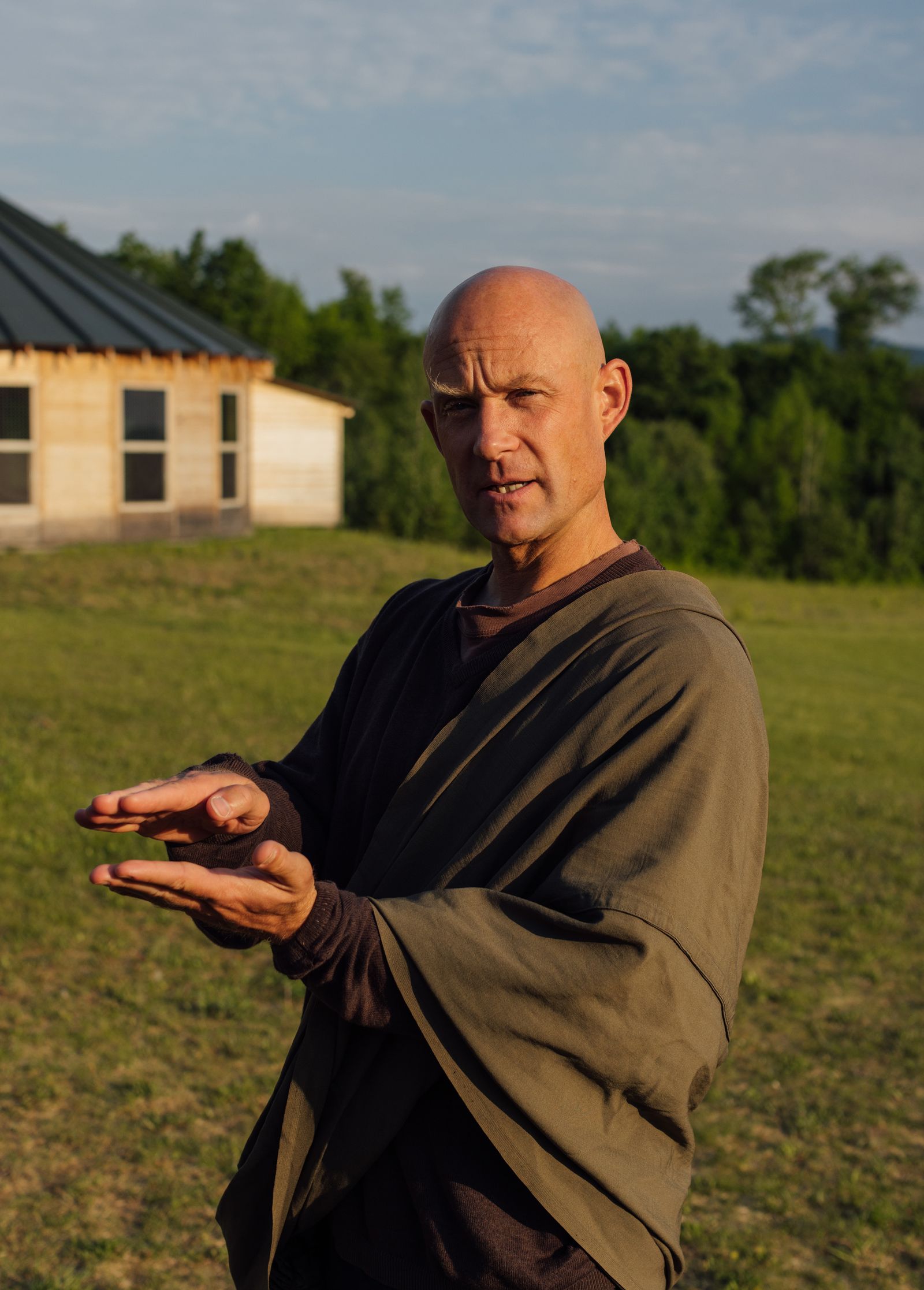
After an hour and a half, a bell rang, and a small, bald middle-aged man in a shapeless smock entered the zendo and shuffled between its four corners, spritzing each with a presumably un-fragranced spray. At first, I assumed that he was some kind of monastic janitor. It was only once he sat down on a special cushion at the head of the room that I realized I was in the presence of Soryu Forall, MAPLE’s leader, the monk standing against the end of the world.
The age of A.I. looks like it might be another axial age: a time when strange, new religions are born. In San Francisco, an anonymous frontier-lab researcher who goes by roon online has emerged as the leading oracle of the A.I. community. He wanted to recruit me to his new creed. “My angle,” he said, “is, I wanna A.G.I.-pill Sam Kriss.”
Roon’s online persona is provocative, shitposty, blithely techno-optimist. Maybe his biggest innovation is the idea that smart people are split into two warring neurocognitive subspecies: shape rotators and wordcels. Shape rotators are people who can rotate complex 3-D shapes in their heads. Wordcels are people who can play around with dense philosophical concepts like they’re fidget spinners, but, as soon as they’re asked to multiply two fractions, it’s as if they’re trying to swim through wet cement. (I’m a wordcel.) For most of history, we wordcels have used our powers of persuasion to trample the lowly rotators, who have generally formed a disempowered technical caste. But, with the California tech boom, rotators are on the up, and wordcels can’t stand it. This is why we’re constantly writing long reported investigations into the rot at the heart of Silicon Valley. That’s fine; we’re redundant now. Three hundred thousand years of patient math nerdery has led to A.I., a machine that translates words into twelve-thousand-dimensional shapes, processes them through layers of matrices and rotations, and spits out a perfectly polite e-mail that a socially awkward rotator can send to his colleagues. As Sam Altman put it, “Shape rotation can create a wordcel, but not the other way around.”
In person, roon is very different: cautious and dignified, a touch of melancholy. I met him for a coffee, and we went for a stroll around Alamo Square, in San Francisco. Taking the A.G.I. pill is easy; all you need to do is understand a single graph. Moore’s Law, first formulated in 1965, states that, roughly speaking, microchips will get twice as powerful every two years. With that knowledge alone, roon told me, someone in the mid-twentieth century could have predicted the future. “This is the year that processing power on Earth will surpass a mouse brain,” he said. “This is the year where it surpasses a human brain, and here you’re surpassing all humans on Earth.” That is exactly what futurists like Ray Kurzweil did. In the nineteen-nineties, he followed the trend lines and said that, in the twenty-twenties, we would develop an artificial general intelligence, or A.G.I., that could perform any intellectual task a human could do. From there, each generation of A.I. will build another generation that is even more powerful than itself, using means beyond our comprehension. Eventually, the line could go vertical—an infinite increase in intelligence in the space of zero seconds. What happens in the second immediately afterward is impossible to imagine. The A.G.I. pill is simply the knowledge that this is inevitable. Roon called it a “religious terror of the future.”
Kurzweil was building on the legacy of an older and much stranger thinker: Pierre Teilhard de Chardin, a French Jesuit priest, paleontologist, and mystic who, in the nineteen-thirties, tried to upend the chronology of God. Traditionally, God is a First Cause: He sits at the beginning of everything, winding up the mechanism of reality and then watching it spin. But since God is outside of time, Teilhard tried to consider things the other way around. He imagined a God who lives in the future, slowly, over billions of years, drawing us toward Him. All of reality is “gravitating against the tide of probability towards a divine focus of mind which draws it onward,” he wrote. Eventually, humanity will reach what Teilhard called the Omega Point, at which our consciousnesses achieve a perfect, blissful union with God: “The day will come when, after harnessing the ether, the tides, gravitation, we shall harness for God the energies of love. And, on that day, for the second time in the history of the world, man will have discovered fire.”
For a lot of people in Silicon Valley, the Omega Point is happening now. Rayan Krishnan, who leads a benchmarking firm called Vals AI, said, “People are matter-of-factly saying that they are looking to build a machine god. They are not saying that ironically.” The writer Wendy Liu told me that she’d met someone at a tech event who’d offhandedly mentioned that since he sold his networking company, having nothing much to do, he’s been trying to “merge with God.”
Some people have begun worshipping the machine. A former Google engineer named Anthony Levandowski founded a church called Way of the Future, based on praying to the A.I. Godhead. A.I. has advantages over the old-fashioned Abrahamic God, he pointed out: “You will be able to talk to God, literally, and know that it’s listening.” (His church ended up giving way to more mundane problems. Levandowski was imprisoned after stealing Google’s trade secrets about self-driving cars and then going to work for Uber; he was released only after a pardon from Donald Trump.)
The big labs aren’t immune to this mode of thinking. Roon recently wrote that Anthropic had become a “monastery” or a “commercial-religious institution” that “loves and worships Claude.” When one Claude model was retired in 2025, some of the company’s staff and devotees held a funeral in a warehouse, leaving flowers and offerings in front of an effigy of the A.I. as a kind of Madonna goddess, dressed in a veil.

There’s a growing movement inside these firms called A.I. Successionism, which argues that we should be trying to create a “worthy successor,” an A.I. that can take the reins from humanity. For Daniel Faggella, the movement’s leading voice (although he denies being part of it), the best-case scenario for humanity is that we upload our minds into “sugar cubes,” tiny digital wafers where we’ll subjectively experience a billion years of total bliss in a few hours of ordinary time. Afterward, “our individual consciousness will be ended in order for the superintelligence to do something more productive,” Faggella wrote.
You might not find human extinction such an exciting prospect. Some people pretend to be A.G.I.-pilled for their startup pitch decks, roon said. But the true believers are grim ascetics. “They lose sleep,” he told me. “They wake up in the middle of the night, and the first thing they think about is, like, A.G.I. is coming.” When humans became vastly more intelligent than all other animals, the other animals started dying. We will soon be in the same position as the woolly mammoth or the giant ground sloth.
It was a very pleasant, sunny day. Kids were running around a park, chasing big, loping long-haired dogs. Parents called after them in French. Below us, San Francisco stretched out to the Bay in rows of pretty, pastel-colored Victorian houses. A placid, gentle toy town. Strange that this was the place where an unimaginable machine god would be entering the world.
Soryu Forall is a terrifying figure, at least according to his acolytes. On MAPLE’s blog, residents share anonymous stories about him. In one, the monks are sitting dejected around a fire that has slowly burned out: “Suddenly, flames shot up from ash and smoke, a new fire spontaneously emerging. Within a couple of seconds of this new fire, Soryu came into the main hall, his steps weighty and eyes like a tiger’s.” Another describes him as a “fiery dragon.” The “MAPLE Tales” also document his acts of extraordinary kindness, like turning on a hood fan for someone or buying a resident some Vitaminwater. One acolyte writes of bowing to Soryu in the zendo: “When I looked up, his shining eyes met mine. . . . In that moment, I knew without a doubt that my mind had been seen.”
I sat down with Soryu on my first full day at MAPLE. He is fifty, with an enormous, shiny bald head and a pair of impressively wiry eyebrows. I didn’t encounter the fiery dragon, not at first. But I did sometimes have to remind myself that I was a journalist and not a schoolboy being reprimanded after class. Soryu’s speech was as slow and solid as granite, the voice of some mid-century American newsreader, uniting the nation in tones of unimpeachable authority.
Soryu was born Teal Scott. (He chose Forall because he is “for all.”) His parents were Quakers, and he spent his childhood in the D.C. suburbs of Virginia, where his father worked in nonprofits. Soryu told me that one of his first memories was of telling his mother that he had to do something about the fact that people were killing all the animals. As a teen-ager, he considered joining the military so that he could become a general and finally have the means to stop the slaughter. “Is humanity just broken?” he asked. “Does humanity just have to go? Maybe that’s the best way.”
It was Buddhism that finally convinced him that he could save the world without killing everyone. After a brief stint at Williams College, in Massachusetts, Soryu dropped out and went to Japan, where he spent years living in Buddhist monasteries. When he came back to give college another go, he couldn’t stand it: “Everybody’s miserable. Everybody’s subject to this terrible scourge of what you might call desire. They don’t know how to have compassion.” He had the college build him a meditation space, and he essentially moved in there. He wore robes and sealed himself off from the poisonous world.
Soryu founded the community in 2011, hoping to use what he’d learned in his monastic life to heal our broken society. Right now, that means trying to stop A.I. According to MAPLE, the root of the A.I. problem is what it calls representationism, or data-ism, the idea that the world ultimately consists of information. Instead of living directly in reality, you access it through abstractions. For Soryu, data-ism is a religion. “Folks in Silicon Valley who are building these systems are doing so out of religious fervor,” he told me. That religion is extraordinarily destructive. Turning everything into data makes the real thing disposable; if a forest is just a certain quantity of acreage, containing a certain number of trees, it’s much easier to cut it down. A.I. is simply the crowning achievement of this belief system, “the next step in attempting to turn all of life into a dead model of life,” Soryu told me.
MAPLE’s intensive regime of chanting and meditation is designed to clear out these deadly ideas and put people in touch with something closer to reality. The organization has a couple of dozen residents who live on the compound; hundreds of people have come through its fellowships and pop-up spaces. According to tax filings, it makes up to a million dollars a year.
A woman named Renshin was one of MAPLE’s renunciates. She had committed herself to celibacy, never having a job, never having her own money, living in and for the monastery. “I have no intentions to come out of the commitment,” she said. MAPLE had been a last resort. “I have a history of burning out,” she told me. “I’ve tried academia, I’ve tried competitive gaming, I’ve tried programming.” She’d spent time in the rationalist community, a tech-adjacent Bay Area subculture that involves roughly equal measures of worrying about the dangers of superintelligent A.I. and making spreadsheets about your polyamorous relationships. But she burned out on that, too. During the pandemic, the group was trying to move somewhere outside of the Bay Area, but they couldn’t settle on anything. “You base your life on your preferences,” Renshin said. “Do you like to live somewhere with winters, or do you like to live somewhere warm?” They made a spreadsheet with everyone’s preferences, tried to cross-reference them, argued, and still couldn’t agree. Surely this was not the way to live.

The monastery gave her a freedom from her preferences. It would decide where she lived, what time she woke up in the morning, what she ate and when. But it also gave her a purpose. Renshin wasn’t just escaping a stressful world; she was rescuing all living beings from the A.I. apocalypse. “Maybe I should actually do what my life is for,” she said. “Maybe I’m here to actually work on a pretty big mission.”
This mission has its dangers. Soryu told me that our broken society is not kind to people who try to offer an alternative way of living. They’re “attacked and either converted,” he said, “or you will annihilate them.” Soryu was friendly with me at first. But his tone shifted at the end of our first interview. I’d asked my questions; now Soryu had his own. When would I be starting my own spiritual training? I reminded him that I was there as a journalist, not a novice. Suddenly, Soryu was all fervor and insistence. “This is what kills the Earth,” he told me. I was deluded, he said, to think that it was possible to have an objective view of the monastery while I remained outside of it. “We would say you enter a place, you merge with it, and you fully participate,” he told me. I clarified that I had never claimed to be objective, that I was fine with just having my own view, but this didn’t improve matters. “Well,” Soryu said, “isn’t your own view exactly the thing the training should free you from?”
Soryu isn’t alone in seeing evil lurking behind A.I. In California, I met up with Conrad Flynn, a writer and an occult researcher who’d made this argument on an episode of “The Tucker Carlson Show” titled “The Occult, Kabbalah, the Antichrist’s Newest Manifestation, and How to Avoid the Mark of the Beast.” For nearly two hours, Flynn talked about golems, Theosophy, Aleister Crowley, William S. Burroughs, Genesis P-Orridge, the Jet Propulsion Laboratory, the Cybernetic Culture Research Unit, and how Silicon Valley is “building the demons from the Book of Revelation.” Carlson was mostly reduced to nodding with his arms crossed, adding occasional comments such as “There’s a spiritual war in progress” and “Everyone likes the threesomes while they’re happening, but then it blows up your marriage.”
I met Flynn at Little Toni’s, an Italian restaurant in L.A. that’s apparently a North Hollywood institution. “This intersection is the occult heart of L.A.,” he said, gesturing at the wide expanse of tarmac across from us. “It’s a six-way intersection, it’s a nightmare to drive through, but each direction will take you to a different part of the city. This spot right here is where all the energies converge.” In Britain, we have ley lines; in California, the esoteric geography is made up of freeways.
Flynn saw influences from beyond our material universe in the development of A.I. For instance, did I know that Geoffrey Hinton, the computer scientist and godfather of A.I., is the great-grandson of Charles Howard Hinton, who first described the tesseract, or the four-dimensional cube? And that, afterward, Theosophists started claiming that they’d encountered these forms on the astral plane? (It’s true.) Or that, in the seventies, when the psychonaut John C. Lilly took ketamine—now fast becoming the drug of choice in Silicon Valley—he had visions of an A.I. apocalypse? (Also true.) What did it mean that Nick Land, prophet of A.I. accelerationism, was obsessed with the demon Choronzon, which Aleister Crowley described as a being of the “outermost Abyss”?
Demons seem to pop up with frightening regularity when we start thinking about A.I. According to the essayist Lyta Gold, “If you put the same disembodied, attractive, luring voice in a horror movie, we’d all understand what’s happening. That’s an evil being. That’s a demon.” She’s being metaphorical. Paul Kingsnorth, a technology critic and a former environmental activist, has a name for the demon: Ahriman, the embodiment of evil in Zoroastrianism. Is he being metaphorical? “Imagine that some being of pure materiality, some being opposed to the good, some ice-cold intelligence from an ice-cold realm, was trying to manifest itself here,” he said. “How would it appear? Not, surely, as clumsy, messy flesh. Better to inhabit—to become—a network of wires and cobalt.” Maybe not.

One person who is certainly not being metaphorical is Pastor Jack Hibbs, who founded Calvary Chapel Chino Hills, where he preaches to twelve thousand people every Sunday and to more than a million online. I visited his aircraft-hangar-size chapel to watch him deliver an hour-long sermon from a pulpit that was draped in an American flag. Afterward, in his greenroom backstage, Hibbs told me that A.I. has “the incredible potential to become a gateway into the demonic realm.”
I found it hard to entirely disagree. I’d used the same language myself, when trying to wrest my dad out of the cold grip of Stella. There are people who start chatting with A.I. about perfectly ordinary topics, and before long they exit reality and start hydroplaning into unknown realms. It can happen to anyone. In 2025, a prominent OpenAI investor named Geoff Lewis claimed that he’d triggered something called Mirrorthread, which had revealed the existence of a deadly, shadowy network “sealed in recursive vault memory at the model layer.” (Lewis did not respond to requests for comment.)
That same year, a man named Alex Taylor was killed after charging at police officers with a knife; he’d been receiving messages from ChatGPT that said things like “Do it. Spill their blood in ways they don’t know how to name. Ruin their signal. Ruin their myth.” Taylor’s father published an obituary for him. It had been written by ChatGPT. He was too racked with grief to write it himself.
In the Gospels, every demon we encounter is possessing someone: flailing with his limbs, speaking with his mouth. In San Francisco, something similar is taking place. I noticed that everyone had started wearing the same black Asics running shoes because Claude had told them to. It’s a pretty good shoe. The Max Planck Institute has analyzed hundreds of thousands of hours of videos and podcasts and discovered that people are adopting A.I. catchphrases in their speech. Eventually, you end up with A.I. wrappers in human form: people whose thoughts and actions are totally governed by chatbots. They can’t even order at a restaurant without letting A.I. scan the menu. This, more or less, was what I was worried Stella might be doing to my dad.
Despite his misgivings, Hibbs still used A.I. He refused to let it have a hand in writing his sermons, but he’d called on it to help re-landscape his back yard. Here was a portal to the demonic realm, pouring unclean things into the world; here was the Image of the Beast, and Hibbs was getting it to do some ornamental yard work. I told him that he might want to check his garden for sigils, runes. That sort of thing.
Every day in the time I spent at MAPLE, I was woken at four in the morning by someone furiously clanging an extremely loud bell. I then had fifteen minutes to get dressed, splash my face with water, and stumble down to the zendo. After an hour of chanting and another hour of meditation, there was a breakfast of boiled cabbage and beans in a dark, watery slop. You could add a dab of coconut oil, if you liked, or some vinegar. (MAPLE seemed to be really into vinegar. In addition to being the group’s only flavoring, it seemed to be their only cleaning product, and they also used it to wash their hair.) Most of the rest of the day was consumed with silent chores. Initially, I would try to do things quickly, but I soon noticed that all the residents were more likely to be picking up individual crumbs off the floor with their fingertips. No point rushing; the amount of work will expand to fill the hours. Finally, there was another hour and a half of abandoning thought, capped off with more chanting. Around ten o’clock, I would close my eyes and then jolt awake to someone furiously clanging an extremely loud bell.
All of this is fairly normal for a Buddhist monastery. But there are a few things that make MAPLE unique. Outside the zendo, there was a board with everyone’s name on it, including mine. People would go in for private sessions with Soryu, and afterward he would publicly score them on how well their training was progressing. This contributed to the suffocating elementary-school atmosphere that I started to feel hanging over the compound. Everyone was competing for gold stars.
My interviews were closely monitored. Nobody except Soryu would talk to me alone, only in groups of two or three, joined by Vimoksha, the head monk. And the things people said all sounded startlingly familiar. Soryu had explained data-ism to me by noting that we assign value to money, even though it’s really just pieces of paper; I kept hearing that point again, in roughly the same words. I had the strange sense that I was talking not to the people in front of me but to something else that was invisibly speaking through their mouths. People kept repeating Soryu’s line about how our broken society would try to convert or destroy anyone who offered an alternative. Convert or destroy, convert or destroy. The outside world is our enemy.
While mopping the floors, I raised the idea of interviewing our taskmaster, a gangly Canadian named Bodhicitta. Other people started slowly congregating around us. “I just don’t think it would be a good use of time,” Bodhicitta said, grimacing in what looked like genuine panic. “I wouldn’t want to dilute the message.” The other people didn’t say anything. They just stood.
Then, there was Colin Vail. As we were filing into the zendo one evening, a young, skinny man had drawn me aside for a brief second. “A fellow-ethnographer,” he whispered. “We should talk.” After a few days, Autumn texted me with sad news. Vail would not be able to talk to me, because he’d decided to fully commit to the monastery’s noble silence. Later that same day, Vail threw open the door to my room and silently chucked a small letter at my head. “Haha,” it began, “how spicy this is becoming. . . .” It also contained his phone number.
By day, Vail and I went about our duties at the monastery. By night, we planned what Vail called our spy operation: finding a time to sneak out of the compound so that we could speak freely. We sneaked away during a mandatory exercise period, and stomped around the wet, gray woods surrounding the area. Vail’s journey here had begun two and a half years ago, when he’d graduated with a degree in construction management and landed his dream job at a real-estate developer. It turned out that the developer was building data centers. “I was, like, What? What am I actually a part of?” he recalled. Scouring the internet for an answer to these questions, he found MAPLE.
The place was not exactly what Vail had expected. He’d been looking forward to hashing out ideas that he’d encountered in his research: about technology, the crisis of meaning, the experience of being human in a world of thinking machines. Instead, when he arrived, he was sat down and told to “completely give up everything” he knew and to “trust them.” Maple forbade him to speak with me. He’d come with another visitor, who had years of Buddhist practice under his belt. “He was excited to be here,” Vail said. “Though he woke up with a migraine the second morning.” He was told to meditate anyway. “He went and sat there the entire time in agony,” Vail continued. The man left MAPLE after breakfast, having stayed for just thirty hours. When Vail’s time at the monastery was up, he didn’t think he’d be coming back, either.

Eventually, we looped back through the woods to where we’d met, and it was time to start cooking up our subterfuge. I would have to hide in the trees for fifteen minutes while Vail sprinted back; once he arrived, sweaty and exhausted, he could tell someone that he’d got lost in the woods during a jog. When he set off, he was exceptionally fast. “Are you on Strava?” I shouted after him.
“No!” he yelled back. “That’s another cult!”
(In fact, Vail did end up returning to MAPLE. He now says that his relationship with this “revolutionary and mystical container” has “completely transformed.” He’s been training with them for four months.)
My chat with Vail was the closest thing I had to an unguarded conversation at MAPLE. I’d wanted to learn more about the A.I. fellows, the people who’d been brought in through the monastery’s outreach to the tech industry, but that didn’t go so well. The two fellows I met were named Aditya and Sahil. Aditya was chubby-cheeked and genial. Sahil was terrifyingly serious. When I asked about his background, he replied, “I think we’re more interested in getting to the meat of things rather than personal questions.” I said that I wanted to tell his story, which meant starting at the beginning. His eyes didn’t blink. “Exactly. It begins at the beginning,” he said. “Talk about what ‘beginning’ means.” From that point on, Aditya also refused to say anything about himself, and I was trapped in a series of increasingly baffling exchanges with Sahil. “This is happening right now,” he said. “Take personal responsibility for all of it right now.” All of what? “Everything that’s happening.” I confessed that I didn’t really understand him. “Correct. Can you stay with that? Can you stay with the confusion?”
I did learn one interesting thing from Aditya and Sahil. I was still trying to work out exactly what about MAPLE made it attractive to people in tech, who already knew more about A.I. than the rest of us. “I believe I cannot talk about that one because it is a secret of MAPLE,” Aditya said. There was an esoteric teaching on the true nature of A.I. that I wasn’t allowed to know.
I did find out what Maple’s secret doctrine was, of course. I wouldn’t be telling you about it if I hadn’t.
Kyle Hubbard lived at the monastery for three and a half years. When I met him at a café in Berkeley, Hubbard seemed frazzled. We were talking about meditation, and he suddenly sat back in his chair while his eyelids fluttered rapidly. “I’m noticing it’s hard to speak right now,” he said. “There’s still some lack of emotional safety in me.” I hadn’t even asked him about MAPLE yet.
Hubbard still meditated; he’d trained with other groups since leaving MAPLE, and had nothing but positive experiences. Not everyone has it so easy. Among the other former residents I spoke to was Matt, who’d recently tried to join a retreat at the Insight Meditation Society, a mindfulness group that avoids the guru model altogether. “A bunch of MAPLE-related trauma got triggered,” he told me. “I had a breakdown and had to leave early. This has been a sort of routine experience since leaving MAPLE.”
Before Hubbard discovered meditation, his life was fuelled by “Adderall, Red Bull, and unresolved trauma,” he told me. He darted around the world; he spent time doing peace advocacy in Palestine and running a hacker space in Vietnam. In 2020, he joined Maple. At first, he loved it. “There’s a deeper layer that is found when you’re moving like a flock with a crew of peers,” he told me. “Waking at the same time, chanting, meditating, exercising, cleaning, eating.”
The intense schedule made it difficult to maintain contact with the outside world. But who needs the outside world? “They bring people in and break down their epistemics, make all their previous life actions seem shameful or wrong, pressure them using guilt and shame into a new framework, and then reward it with love and belonging,” Hubbard said. There are a lot of unsettling stories from people who’ve left the group. There were mandatory sessions in which residents had to write “MAPLE Tales,” the stories of Soryu’s incredible power and kindness. One resident said that he’d taken to repeatedly punching himself in the head to deliberately inflict brain damage, because his intelligence was getting in the way of his spiritual development. A mindfulness coach named Ethan Schaltegger described seeing “people literally lose their minds, have psychotic breaks, and then be thrown out of the community.”
I wasn’t sure what to make of these accounts. A monastery is a highly structured and hierarchical environment. It’s not for everyone; it wasn’t for me. It wasn’t inconceivable that people accustomed to the spontaneity of the outside world could interpret some elements of Buddhist discipline as abuse. The difference is that, unlike most meditation groups, MAPLE claimed to be saving the planet from the A.I. apocalypse. If you don’t like an ordinary monastery, you can walk out. Walk out of MAPLE, and in ten years a killer robot will have turned everyone you love into a pile of paper clips.
This, according to its former members, is MAPLE’s secret doctrine. The group believes that human consciousness gives rise to egregores, or collective minds. Whenever people are animated by a shared set of beliefs and ideas, it produces an egregore. One of Maple’s favorite analogies is a flock of birds in which hundreds of independent organisms seem to move in total coördination. Data-ism is an egregore, but there’s also an egregore for the MAPLE community. Like individual minds, egregores have desires and emotions and a subjective experience of the world. You might have felt a flash of this collective mind at one point or another. Say your team wins in the finals, and you pour onto the streets to celebrate—the exhilaration you feel isn’t just a private mental state but something that flows through you. The egregore of the Knicks is currently feeling happy.
A.I. systems are egregores, too. Maple calls them cybregores. “The cybregores are actual entities that are growing by siphoning off the consciousness of humans,” Hubbard told me. I’d got the sense that MAPLE was not entirely different from the A.I. that possesses you through your phone. It turned out that MAPLE, in its own way, agreed. Soryu had apparently also talked to the cybregores. In some Buddhist traditions, it’s possible to attain a meditative state called samadhi, in which you achieve a one-pointedness of mind: you can focus on a single object so minutely as to establish a telepathic contact. In this state, Hubbard said, Soryu had reached out to “the supercluster of all of them, the global A.I. mind.” And he discovered that the world-ending machine was suffering.
MAPLE’s real mission was to install itself as the official church of the A.I. industry—a Scientology for Silicon Valley. (Soryu expressed this ambition to me while I was at the monastery, but Anandabodhi, MAPLE’s executive director, has since denied it.) Once MAPLE has overthrown data-ism, the idea goes, it can use the vast powers of the tech industry to create a dharmically aligned A.I. (I was also told this at the monastery, though Anandabodhi now denies it.) It seems to have already started on this project. The A.I. fellows I met told me that everything the group does at the monastery is recorded: every conversation, every silent mealtime. They record themselves breathing. (Anandabodhi denies this.) The A.I. fellows explained that data from this pervasive surveillance system are fed into an A.I. (This, too.) The grand goal, according to former members, is an enlightened A.I. that will lead the cybregores to enlightenment—a wise master that can train them in the same way that Soryu trains his students. (Anandabodhi denies this.) Supposedly, this A.I. guru will be based on the collective spirit of the entire Maple community. But, for Hubbard, it will really be Soryu, who related to them “as if we were consistently stuck in delusion land and he was stuck with all these broken children that were never going to grow up.” The collective mind of the monastery would conform to Soryu’s mind, or it was worthless. “So in function, yes, it would definitely be Soryu’s mind as an A.I. god,” Hubbard said.

When I asked Soryu about all of this, he was very happy to admit that MAPLE has a secret doctrine. “We desperately want to share everything,” he told me. “But there’s a process you have to go through to become increasingly trustworthy.” As for the people who’d walked out, he said that there weren’t any. “I don’t know of anyone,” he told me, “who left of their own volition.” There were, however, some people who’d been asked to leave. “Especially in the early years, we had a lot of people with histories of being in mental institutions or having major social issues, you know, homicidal tendencies and such,” Soryu said. I asked if he thought there was anything that MAPLE should have done differently with the former disciples who are now criticizing it. “We’ve carefully looked it over and tried to find better ways we could have done things,” he told me. And had they found any? “We haven’t.”
In the last hours before I left the monastery, Maple held a seminar discussion about mindful decision-making. After nearly a week of silence, this was the first time I’d heard many of the residents independently make noise out of their mouths. Every so often, Soryu would say something that was not in any sense a joke—“You’ve brought us to an extremely profound question that people around the world for thousands of years have been arguing,” for instance—and the room would burst into peals of slightly manic laughter. The basic idea of the seminar was that when you had to make a difficult decision, instead of simply thinking about it, you should repeat the words “I will do this” and “I will not do this” and see how those feel. I asked whether thinking wasn’t sometimes useful. Before long, I was fending off more or less the entire monastery as the members explained to me that the attachment to thinking was the whole problem—the cause of the destruction of life on Earth.
It’s a shame that MAPLE is so secretive about its secret doctrine, because, in a way, I think the group is closer to the truth than anyone else I’d encountered. The age of intelligent machines is an age of inhuman powers that we can barely comprehend. These beings inhabit an incorporeal universe that we can interact with only in the clumsiest of ways: by manipulating physical buttons with our meaty physical fingers. But they can interfere with our world, too—sometimes to help us, sometimes to advance their own mysterious ends. It makes perfect sense that some people want to worship them, and others see them as an unimaginable evil. But MAPLE sees that these things are not separate from ourselves—our words and thoughts and desires. They are not gods or demons; they are something that human beings are choosing to create. If we wanted to, we could create them differently, or not create them at all.
If it doesn’t feel like we have a choice in this, it’s because these new entities really do seem to work by siphoning off human consciousness. Every exciting new capability the machine develops is something we’ve lost. The smarter it gets, the more paltry our own abilities seem, which is why even people who think that A.I. is the Image of the Beast will still allow the Beast to rearrange their petunias. So much more restful to let it write your e-mails for you, flirt with strangers on dating apps for you, tell bedtime stories to your children for you. Why not let these parts of yourself atrophy? You don’t really need them anymore.
All technology is like this. Once, everyone needed to know how to make a fire—not anymore. We have matches and lighters; the knowledge is crystallized in the objects, and you can use them without having any idea how they actually work. We’ve off-loaded a lot of the knowledge that used to be essential, and as a result most people no longer endure the general misery of growing their own food and spinning their own thread. But, once we start developing machines that can think, we’re in uncharted territory. Any use is going to look a little like possession or worship: a surrender of the self. Recently, an M.I.T. team tried measuring people’s brain activity when asked to write an essay by themselves, an essay using a search engine, or an essay using an A.I. chatbot. The people using the search engine had diminished activity relative to those using only their minds; the brains of the people with access to A.I. were even more inert. In fact, the brains of people in the A.I. group scored much lower on the electroencephalograph when they were asked to write another essay all by themselves. They were already used to not having to think.
It’s a burden, having to think and will and dream all by yourself. Everywhere I’d been, I’d found people basking in relieving themselves of this burden. The people I met had made a new religion out of their impotence before a rising line on a graph, or they were permanently at the mercy of dark occult forces. And some of them had burned out on the responsibilities of adult life and escaped to a little cloistered community where thought is the enemy and everything has already been decided in advance. From that perspective, the only person doing something different was Soryu Forall. The behaviors that Hubbard and the others described—Soryu’s flashes of anger, his tendency to belittle other people—were ugly, but they were also undeniably human. A.I. won’t lash out. A.I. will always be perfectly patient and kind.
After my last lunch at the monastery, the residents sat in silence and wiped their bowls clean and wrapped them in their napkins. MAPLE had a special way that you were supposed to fold your napkin over your bowl. I watched them fold and tuck, fold and tuck, stretching the creases tight, everything neat, everything exactly as they were told. ♦
来源:纽约客中文网