 讲知识 · 讲经验 · 讲未来
 人人可分享 · 处处是课堂
 科技 · 财经 · 游戏 · 快讯,每日更新
 诚搜315观察网
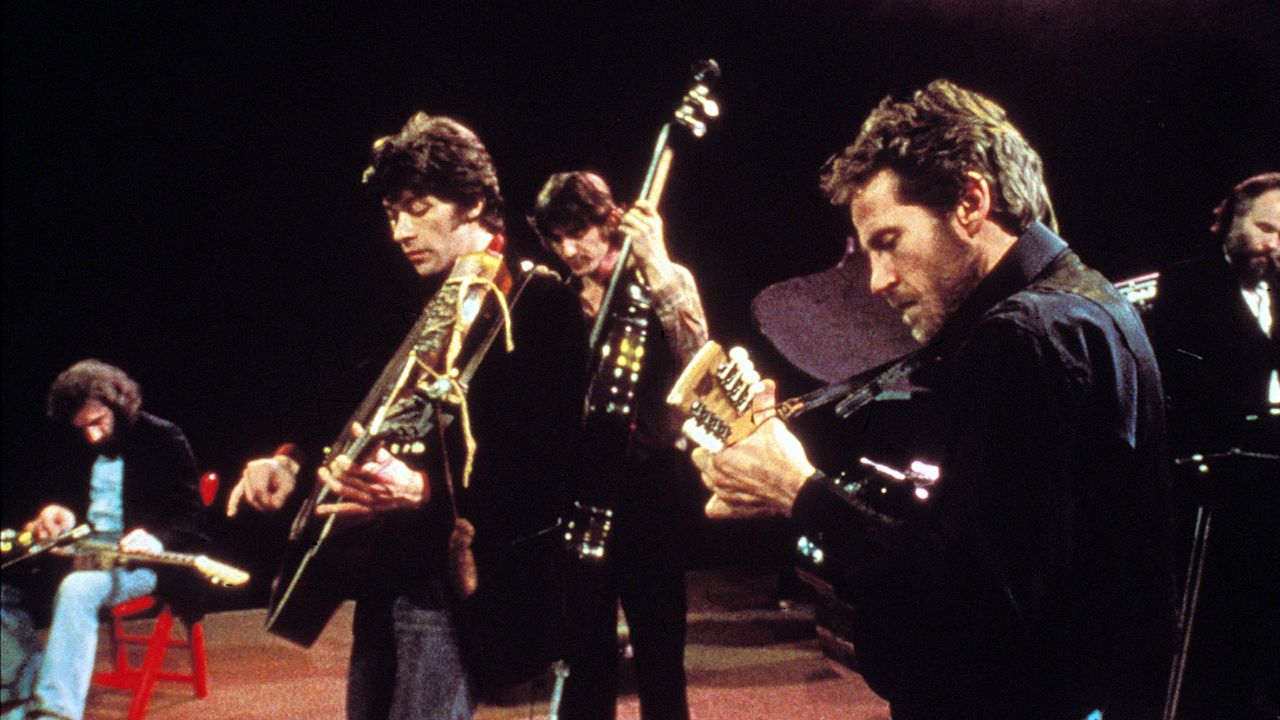
To my mind, one of the single greatest live performances one can see exists midway through the concert film “The Last Waltz.” Directed by Martin Scorsese, it documents the final concert of the Band, on Thanksgiving Day, 1976, at Bill Graham’s Winterland Ballroom, in San Francisco. The performance is from after the concert was filmed, when Scorsese shot for multiple days at a studio soundstage on the M-G-M lot, capturing the Band playing their most famous song, “The Weight,” alongside the Staple Singers. The soundstage is, aesthetically, a sharp departure from the Winterland stage. The lighting is sparse, with a red-orange hue shooting across an otherwise black backdrop, slightly tinting everyone it falls upon in a way that makes them look as if they are bathing in a final gasp of sunlight before nightfall. The group trades verses of the iconic song with the Staples Singers. Levon Helm takes one, Pops Staples takes the next, Rick Danko takes another, and Mavis gets a verse—Mavis sings her brief verse with an air of delight and revelation, as if she’s enjoying a meal made by someone she loves. She comes back in the song’s final verse, and by the closing moments she’s in full gospel mode, clapping her hands into the microphone, overcome, reaching into the open mouth of the folk song and pulling a bit of God from beneath its tongue—a bit of God which, in the case of “The Weight,” is never hard to find.
The concert recorded in “The Last Waltz” is marking its fiftieth anniversary this Thanksgiving. For almost half of that time, I have had a tradition of watching the film every year on Thanksgiving Eve. Like most of my traditions, this one began when the thought of solitude became unbearable, which, at nineteen years old, was almost always. At that age, doing anything with anyone seemed better than doing something I loved alone. In college I was among the misfits, the people in my dorm who either couldn’t go home for Thanksgiving or wouldn’t: the ones who lived too far away to travel back for both Thanksgiving and Christmas; the ones who’d been dropped off on campus earlier that fall by parents who didn’t even bother to get out of the car; or those, like me, whose families didn’t care much about gathering for this holiday or any other.
There were about nine of us left over, and we had the run of the dorm, which had a large television and a new DVD player. There was a Blockbuster within walking distance, and I knew that none of us wanted to be alone for the holiday in the large, echoing dorm building, thinking about those whom we missed or were too mad at to miss. And so I rented the newly released “Last Waltz” anniversary DVD and ordered some pizza, and that Wednesday night all nine of us crammed into the TV room and watched it together. It was my first time seeing the film in full. We laughed at the interviews and scenes interwoven among the concert performances: Danko, Richard Manuel, and Robbie Robertson talking about how, in the early days, the Band would wear massive overcoats and steal food from the supermarket on the road. In one scene, a clearly drunk Danko plays “Old Time Religion” on the fiddle with a small black hat resting atop his head. As we got deeper into the film, many of my comrades fell asleep, but I realized that I didn’t need the screening to be a group activity. The film was teeming with companionship—Neil Young bouncing over to Robertson and Danko to share a microphone at the end of a stunning rendition of “Helpless,” or the Band’s first leader, Ronnie Hawkins, shouting at his old backing band as if they were still his backing band and not veteran headliners themselves. The film itself was an antidote to loneliness, a vision of a life lived well.
I am more rigorous about my “Last Waltz” tradition than I am about most other rituals. I have watched the movie every year since that first time, and always alone. I generally commit myself to not being on the road for the holiday, but in the rare times when I have been, I’ve closed myself off in whatever hotel room I’m staying in and found a way to stream the movie on the hotel TV. I have not, since that first college viewing, been interested in sharing the experience with others. I am especially not interested in serving as a tour guide for someone who has never seen the film, even if this is antithetical to my usual impulse of finding someone, anyone, to share the things that excite or bewilder me. I only watch the movie once per year, on the day before Thanksgiving. It is a foolish superstition, but one that I stick to.
“The Last Waltz” manifests itself to me differently every year. The film ages and I age alongside it, and in the process I find new moments of tenderness, or old moments of tenderness that have tuned themselves to aches in my heart that hadn’t existed the last time I watched. Take, for example, the aforementioned performance of Young’s “Helpless.” Some viewers tend to focus—foolishly, I might add—on the clearly dazed onstage presence of Young as an example of the not so subtle drug use happening off camera. This kind of pearl-clutching seems to risk emphasizing the very ordinary at the expense of the extraordinary, which, in this case, is a moment when Joni Mitchell starts singing from a hidden perch backstage, invisible to the audience except as a shadow underneath the curtain. Onstage, Young, Robertson, and Danko (who do know that Joni is there, and have situated her there specifically for this moment) playfully look to the heavens, as if to say, The angels are here, among us.
“Helpless” is, broadly, a song about reaching through the devastating and overgrown acres of memory. If I were to sit beside you watching this scene I would ask about people you miss: what their singing voices sounded like, if you can remember; how long they’ve been gone and at what point their voices began to fade in your mind into intermittent static. For me, there is a new voice that begins to fade every year. Someone who has died, or otherwise left. The symphony of their living becomes first flimsy, and then gone. I like to imagine the moment that the audience watching the Band could hear a voice they loved but couldn’t see where it was coming from—the split second, before logic kicked in, where they did think that something was falling upon them from the same heaven their beloveds were in.
In its best moments, “The Last Waltz” highlights the affection and camaraderie among the bandmates and their peers, which means that much of the friction that is known to have existed within the group at the time is barely visible, especially if one doesn’t know what to look for. By 1976, Robertson was done with being on the road. The Band had spent more than fifteen years touring non-stop, first as the backing band for Hawkins, then backing Bob Dylan, and then on their own. The other members of the Band didn’t want the show to stop as Robertson did, and so humming underneath their farewell concert was the drama of one member walking out on his own. The Band, sans Robertson, reformed and started touring again in 1983, but the tensions continued and grew, to the point where, when the Band was inducted into the Rock & Roll Hall of Fame in 1994, with Robertson joining them, Helm stayed home. But even knowing all of this, you might watch “The Last Waltz” and forget the grievances. There is a moment, in one of the interstitial storytelling scenes, when Helm lights a match, mid-sentence, and holds it toward Robertson’s cigarette before he lights his own, before Robertson could even gesture to ask. When the group performs “Who Do You Love” with Hawkins, and he playfully storms offstage, leaving the Band to find their own close to the song, Robertson and Helm momentarily look at each other, laughing, perhaps remembering what it was to be young and briefly lost.
At the same time, it’s become clearer to me as I’ve aged that a central engine of “The Last Waltz” is grief. There’s a scene that takes place after the concert ends, when Martin Scorsese goes to visit Danko in Shangri-La, their Malibu clubhouse and studio. After a brief tour of the space, Danko sits down at a control board, and Scorsese asks him what he’s been doing since “The Last Waltz.” Danko reaches for a wide-brimmed hat, puts it on his head, and asks his engineer to press play on a song. As the first notes of his then new solo song “Sip the Wine” come through the studio speakers, Danko responds, “Just making music, you know . . . trying to stay busy. It’s healthy.” As the song continues to play, Danko leans back in his chair and smiles at Scorsese, as if he knows he’s done something miraculous. But then he turns back to the control board, his hat obscuring most of his face, and as the camera zooms in it becomes evident that his smile is gone, his self-satisfaction suddenly wrecked by an understanding that he was doing a significant thing alone. Danko is my favorite of the Band’s vocalists. Everything he sang sounds like pleading, mourning, suffering, like the stakes couldn’t be higher. Every note sounds as if he was watching the final threads of a memory slip through his fingers. But the scene might be heartbreaking only because of what I know of its aftermath. Manuel would die less than eight years later, by suicide. Danko’s first son would die, after a night of binge drinking, three years after that. The Band’s remaining members would face dwindling popularity in the eighties, playing smaller venues with far less fanfare. At that moment in “The Last Waltz,” playing a new song for Scorsese, Danko looks as if he’s already mourning the future his dream won’t survive in.
Helm, though, played until he was damn near gone. One of the disconnects between him and Robertson was that Robertson seemed to view being on the road and the stage as a hazard to his life, whereas Helm could not imagine a worthwhile life without it. In one of his last shows before his death, in 2012, from throat cancer, he sang a cover of Ralph Stanley’s “Gloryland,” which is a song about leaving the earth behind. In “Gloryland,” there are no undertakers because no one dies. There are no doctors because no one falls ill. Your earthly pain won’t be making the trip, and you have friends already in Gloryland—the one who hung himself in a motel room, the one who sang like his heart was a hundred puzzle pieces from a hundred different boxes until it gave out on him way too young, the one who took too much of something just the one day. During his life’s final act, Helm performed the generous gesture of singing about where he believed he was going, and where he believed they’d be going one day, too. The song insists that we are all spending a lifetime travelling toward another lifetime, and death is the door we have to slip through.
I would like to believe in the place that Helm is singing about. You don’t have to be who you were. Whatever haunted you once doesn’t need to haunt you always. Because my “Last Waltz” tradition was born out of isolation, I decided along the way that it had to be defined by isolation. This year, however, I am spending Thanksgiving week with my fiancée, and I have limited ability (or desire) to close myself off in a room for a couple of hours. She’s never seen the film, and knows very little about it beyond the fact that I watch it every year. And so, for the first time since I was nineteen years old in a mostly abandoned college dorm, I am going to watch it alongside someone else. You don’t have to be who you were. ♦
来源:纽约客中文网