 讲知识 · 讲经验 · 讲未来
 人人可分享 · 处处是课堂
 科技 · 财经 · 游戏 · 快讯,每日更新
 诚搜315观察网
One of the first recipes ever cooked on American television was made by James Beard, on a show called “Radio City Matinee,” in June, 1946. It was filmed on a soundstage, with two cameras, and aired live. The dish was a baked striped bass. Beard assembled onions, parsley, lemon, olive oil, butter, and a bit of white wine. Not that many people watched it—TVs were mostly a luxury—and Beard wasn’t a natural. (He “was never totally at ease on television,” his biographer wrote. “His bald head lit badly.”) But it was the start of something new. Previously, chefs taught you to cook through books, magazines, or the radio; now you could see the food. Beard rubbed the skin of the fish with garlic, then chopped the onions and stuffed them into the cavity. He showed the viewer how to close up the fish’s belly with a common kitchen tool: toothpicks. And, he said, because “the people who cook better than any other people”—the Chinese and the French—do, he made a point of cooking the fish with its head still on.
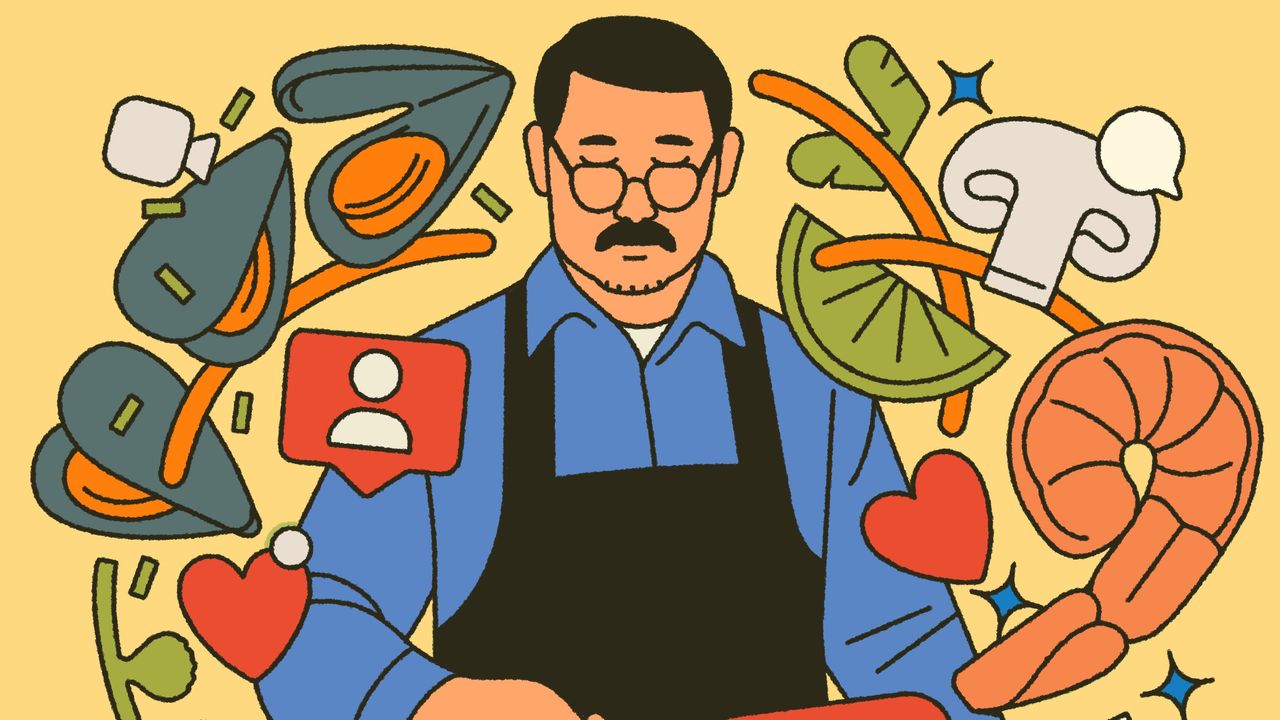
Recently, I came across a similar dish on Instagram: it was a fifteen-minute, post-workout sheet-pan salmon. I like to cook, and I learned from watching TV. My parents are not great cooks; growing up, I religiously watched food shows and devoured cookbooks and magazines. But, of late, most of my recipe inspiration and cooking tips have come from Instagram, a platform that I otherwise see, warily, as a net negative. In recent months, I have made: waterless braised pork belly (I added some water), Chinese soy-marinated roast chicken (didn’t work), radicchio pasta (mistake), and an ’nduja carbonara (game changer). My most active Instagram D.M.s are me sending recipes to myself. For a chef, the path to a career writing recipes used to involve working one’s way up through a restaurant or a food publication, running a successful blog, or landing a TV show. Today, you can post on Instagram.
Among the food-fluencers, one of my favorites is Hailee Catalano, a former restaurant chef who cooks online with a summer-tomato-bright disposition. (She rose to prominence making enormous sandwiches.) Every Thanksgiving, Catalano walks her viewers through a stunning but achievable three-day prep course—batches of browned-turkey-wing stock in cheffy plastic tubs, a make-ahead herby-sausage stuffing. Catalano is an interesting hybrid: like a previous generation of celebrity chefs, she went to culinary school, worked as a line cook for seven years, and has a cookbook—a 288-page volume called “By Heart”—but, unlike them, she came up entirely through Instagram.
A few weeks ago, Catalano invited me to watch her film a video at her home, in a quiet suburb on the Jersey Shore. As I arrived, she waved from the window of a low-slung white bungalow. Inside, I shook hands with her and her partner, Chuck Cruz, who is also a chef with an Instagram presence, and whose meat- and spice-forward braises I’ve long been entranced by. Catalano wore a plain black cardigan and plush slippers. Cruz was holding their dog, Gus, a small terrier-Shiba Inu mutt. It was an autumn morning and Catalano was making a sausage-and-butternut-squash pasta, from her cookbook, that was an alternative, she said, to a creamy corn orzo of hers that was very popular around this time of year.
I had expected a bit of a production—cameras, lighting—but all Catalano used was an iPhone in a green-gingham case that complemented her mostly orange kitchen. “We tried to buy lighting stuff once, but it gave us a headache,” she said. With very little fuss, Catalano diced a plump shallot and mandolined garlic into papery slices. She spoke into the camera for ten to fifteen seconds at a time, then ducked to the side to consult her cookbook. I sat at her kitchen island. It felt surprisingly like being at a friend’s house for dinner. In a restaurant, Catalano said, she would have been at a station with multiple pans, searing and sweating.
Catalano started posting recipes on Instagram during the pandemic; she had moved from Chicago to New York to break into the local restaurant scene, but then many of those restaurants shut down. So she started posting to social media. Catalano told me that, before that, she had spent years applying for jobs at places like Bon Appétit as a recipe writer or in the test kitchen, but was never hired. Then, on TikTok, a dish of hers took off.
Catalano finely sliced a handful of chives and served me the pasta: the sauce was perfectly emulsified and deeply savory, with a little warmth from a hit of nutmeg. On the table in front of me was a pile of food magazines, and I leafed through Food & Wine. (“The King of Flour”; a recipe for lu rou fan, Taiwanese pork belly rice; and an essay on the joy of persimmons.) Catalano told me that, as a child, she would wait for the arrival of a new food magazine every week, and cook from them with her mother. “There’s something about flipping through a book that is just not the same as scrolling on your phone,” she said. When she makes a video, it can feel like it goes into the ether. But when someone makes a dish from her cookbook, she said, “Hopefully there’s a splatter on it now, you know, from the last time they made it.” The doorbell rang with a delivery: mounds of chicken wings and thighs, scallions, celery, and water chestnuts, for their next video—Buffalo-chicken lumpia and fried wings with a fish-sauce ranch, from Cruz’s début cookbook, which he had just announced. They took out twin chopping boards and started prepping side by side.
Let’s say you can cook. Do you need to be on Instagram to make a career out of it? With food, as with music, sketch comedy, fashion, books, and journalism, Instagram exacts a familiar trade—it democratizes the opportunity to be discovered but supplants the way people in that industry made a living. In addition to her cookbook, Catalano has a website where she posts recipes, but she told me that she still makes most of her income through Instagram, from brand deals, especially. She doesn’t monetize the views—partly, she said, because she thinks that doing so deprioritizes her in the algorithm.
I started working in journalism in the mid-twenty-tens, which means I was scarred by the “pivot to video,” a collective mistake in which news organizations rebuilt themselves to focus on producing videos for Twitter and Facebook, which had skyrocketing views. Then Facebook stopped prioritizing news, and swathes of people in media were laid off. Around the same time, I read “ ‘Link in Bio’ Is a Slow Knife,” an article by the technologist and writer Anil Dash, which argues that Instagram, by attempting to become a one-stop shop for people to promote their work, is subtly killing the things that feed it.
Cruz and Catalano told me that a cozy Instagram series they film together called “Friday Night Dinner” had been inspired by “Two Fat Ladies,” a sedate late-nineties English cooking show. “It’s not exploding with cuts and editing,” Cruz said. “It brings it back to old school.” It usually runs in the ten-minute range. But, recently, a notification on Instagram had told them that reels longer than three minutes wouldn’t be shown to new audiences. “We do it for the love of the game,” Cruz said.
I thought of Alison Roman’s empire: she came up through Bon Appétit and Instagram, but now has a newsletter, five cookbooks, and will soon have multiple physical stores, which all seem pointedly engineered to avoid the dependence on the whims of a single platform. Chefs, like magazines, Netflix, and Instagram, are now in the business of attention, Mehreen Karim, another chef, told me. Karim worked as a recipe-production assistant at Bon Appétit, and cooked on “Next Level Chef,” a competition show hosted by Gordon Ramsay. (She came in sixth.) Now she hosts a show called “Picky Eaters,” which airs only on Instagram and TikTok, and is essentially a remake of old Food Network shows like “Beat Bobby Flay.” On each two-to-three-minute episode, a guest judge (often an influencer with a large following) picks an ingredient that they hate, and Karim and a guest chef compete to make the best dish possible from it. Past judges: Padma Lakshmi, the self-taught baker Aimee France. Past ingredients: olives, white chocolate, dill.
One morning, I dropped by the set of Karim’s show, which, that week, was being filmed in a for-hire kitchen space in Williamsburg. On a table were long-stemmed scallions and tangled varieties of mushroom, from the day’s first taping, which had featured the chef Matthew Cutolo. Karim wore a black-and-white top, black leggings, and New Balance sneakers, and was eating lunch. In addition to hosting the show, in a model of modern-chef precarity, she juggles writing recipes for Substack, pitching recipes to magazines, and working at restaurant pop-ups.
I arrived in time for that day’s second episode, whose guest judge was an eight-year-old child named Wren, who hates blue cheese. “We don’t really have a greenroom,” Alex Berry, the creator and showrunner, said apologetically, as he ushered in Wren’s family. “We’re about to start cooking in three minutes, so it’s hectic,” he told me. Around Karim buzzed four camera operators and two production assistants. A bank of monitors showed the action at every moment, with a glowing green vertical frame in the center of the shot, the shape of a phone. The competing chef was Carla Lalli, a former Bon Appétit star, who had also hosted her own cooking show, on YouTube.
“Everyone watched Carla, and Molly Baz, and that entire set of colleagues, and dreamt of working in food media,” Karim told me. “It’s crazy that five years later she’s on the set of a digital show that I’m the host of. That’s fucking weird!”
When I watched “Picky Eaters,” something that appealed to me was that, for a show available only on social media, it seemed rooted in the real world. The guests plug cookbooks and newly opened restaurants. That day, Lalli was cooking blue-cheese biscuits, a spin on a recipe in her latest book, “Food Is a Feeling,” that was, itself, based on a snack she used to make as a line cook early in her career. At one point, Karim held up Lalli’s book and started reading a passage on camera. “That’s a good TV moment,” Berry said. Lalli was also modelling a new Lalli-brand apron—a rustic brown smock with dainty epaulettes—that she sells online. Karim put one on, too. “We look like little milkmaids,” she said.
Karim was making a blue-cheese cheesecake, in the Basque style. “Anyone now can be a chef” on Instagram, Berry told me. The conceit of the show was a kind of response: “This, is, like, ‘No, I really want to see if you’re a good chef.’ ” The show’s forty-minute limit was rigidly enforced, and there were pleasing notes of panic. There were no do-overs. (“Can I get a timer for my biscuits?” Lalli asked. “We don’t do timers,” Berry told her.) Some Instagram chefs, Berry told me, freak out. But Karim and Lalli spoke into the camera while amiably shuffling hot sauciers, laminating dough, and reducing sputtering caramel. As Karim’s cheesecake baked, the kitchen started to fill with dark, edge-of-the-pan smells. I imagined sugars burning and corners sticking. Lalli had already pulled her biscuits. Karim waited a bit longer. When she extracted the cheesecake, it had an effortlessly browned halo and a golden center. Karim furiously spooned caramelized apples on top. Lalli arranged some potato chips on the side, and turned her plate toward Wren.
As they waited for her verdict, Karim and Lalli stood in a hallway and kibbitzed about the economics of food with the day’s third competitor, Alex George, a baker who started out blogging. “I did everything you’re not supposed to do if you want to make money,” Lalli confided, of the aprons. “If I sell all of the first run, I will make back what I spent. And, if I sell through the second run, maybe then I’ll make a profit.” It’s similar with cookbooks, she added. “It’s, like, the success is, I didn’t lose money.” George, who had just published her first book, said, “Thank you for being so transparent.” Back in the studio, Wren sat in front of the winner’s dish, hidden under a silver cloche. I had tasted the food on the side: the biscuit was crisp, with astonishingly flaky layers of striation inside; Karim’s cake had a savory depth from the blue cheese. (I slightly preferred the latter.) Wren lifted the lid. Lalli had won. “I can’t even be mad,” Karim said.
After the shoot, I asked Lalli: Can a chef make it today without Instagram? “I would like to say yes because Instagram is evil,” she said, but conceded, “Brains are broken.” Like most chefs I spoke to, Lalli said she wished there was still a place for longer, in-depth food media. (“Once Stanley Tucci’s show got cancelled, I was, like, Don’t even feel bad about it—the Tooch can’t get a show!”)
Berry told me, “I want to make Mehreen the next Bobby Flay.” But Bobby Flay’s shows were longer than three minutes. Karim told me that she wants to make episodes longer, film horizontally, and upload them to YouTube. During the competition, Karim had geeked out about laminating the biscuits and adding fat, which Lalli explained “mellowed out the sharpness” of the blue cheese. I kept thinking of how many of these details would be cut. The action on the monitors was focussed on the bright green vertical box; more things were happening outside those edges.
In the introduction to Catalano’s cookbook, she writes that her dream is to own and operate a small restaurant, perhaps somewhere in Jersey, with Cruz. When she first started posting on Instagram, the aim, she said, was to “save, like, an extra hundred dollars here or there every month” and put it toward a restaurant fund.
The second season of “The Bear”—an otherwise sort of fantasy-football vision of chef life—has a memorable sequence in which one of the characters, while planning her new restaurant, reads through a list of Chicago eateries that have recently shut down. I asked Catalano if opening a restaurant was still her dream. “It’s always still in my mind,” she said, but added that it was now more of a “ten-year plan type of thing.” She missed being able to actually see people eat and enjoy her food. “There’s a lot of cute little small towns that I still have that hope for,” she said. But restaurants are hard. Line cooks get burned out. What if making videos on Instagram was always the easier option? “I know what you mean,” she said.
A few weeks after I visited Catalano and Cruz, I spontaneously decided to cook one of the meals I’d seen them start to make. I had been thinking about the fish-sauce wings. I went on Instagram and found the video they made on the day I’d visited. It wasn’t an actual recipe; there were no measurements. Still, I scrolled back and forth a few times with my finger, and jotted down what he put in the marinade: coriander stems, garlic, fish sauce, soy sauce, sugar, and hot sauce. I eyeballed it. I had no idea how it would turn out—Cruz’s wings are fried, I baked mine; Cruz used an immersion blender, I just chopped my herbs as finely as I could—but I had some practice making wings from a lifetime of cooking. I had learned how strong fish sauce was and how to make a standard Vietnamese marinade from TV shows and recipes I’d half forgotten. I knew how browned I wanted the wings to be from a sticky-barbecue-chicken dish I’d had at a friend’s house. I added a little baking soda, which is a trick I learned from a food blog. I tasted the sauce and thought about it. I put them in the oven for forty minutes, twenty minutes on each side. They came out great. ♦
来源:纽约客中文网