 讲知识 · 讲经验 · 讲未来
 人人可分享 · 处处是课堂
 科技 · 财经 · 游戏 · 快讯,每日更新
 诚搜315观察网
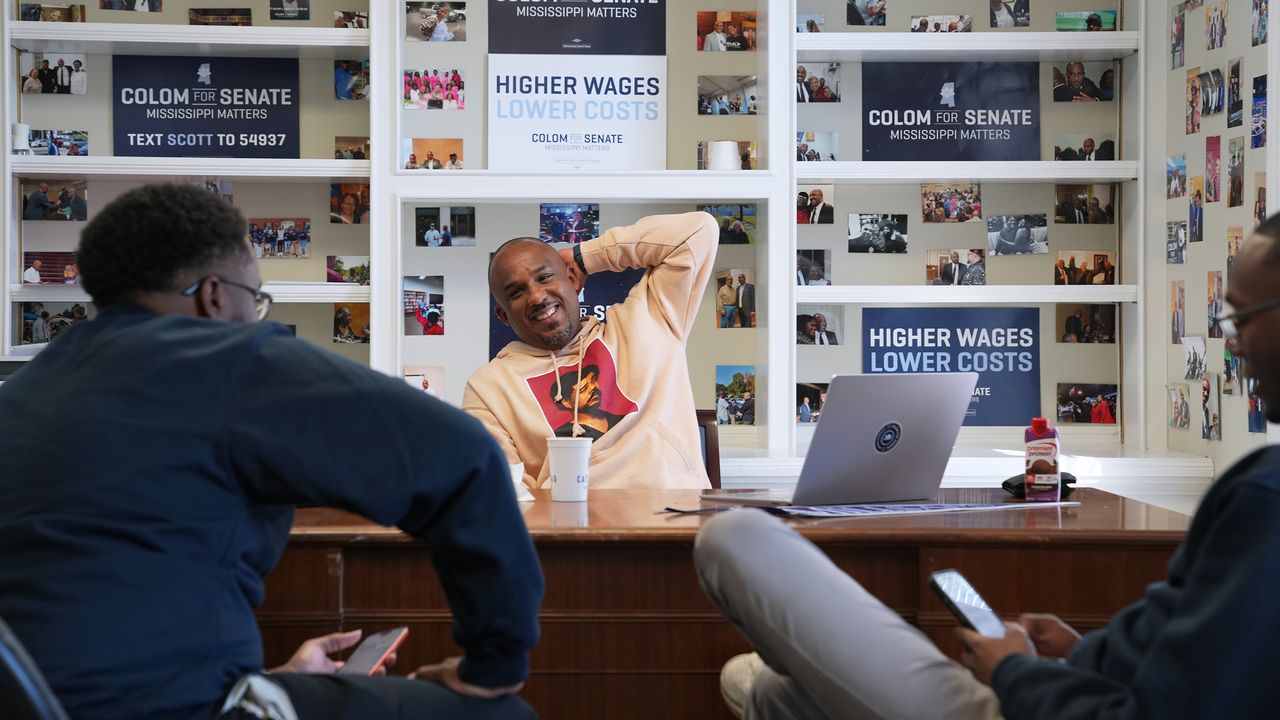
A few months ago, a retired newsman turned woodworker named Roger Larsen was busy refurbishing an old brick building that he owns in Columbus, Mississippi, when he saw his former neighbor Scott Colom filming an ad for his Democratic senatorial campaign on the steps of the county courthouse, across the street. Larsen is a conservative (“Alan Keyes was the last Presidential candidate I was excited about,” he said), but he admired the job that Colom had been doing as a district attorney for the past decade and said so. “I told him—of course, he wasn’t expected to win—I said, ‘When you win, Scott, I want you to have my building as your district headquarters.’ ” Larsen’s building is likely too small to be of practical use to Colom now that he has indeed won, becoming the state’s first Black senator-elect since Reconstruction. Just a couple of rooms, it was the Curly Top Beauty Shop for many years in the middle of the previous century. But it was originally built as a law office for James Thomas Harrison, a deputy to the Provisional Congress of the Confederate States. “Scott said that it would be symbolic,” Larsen recalled.
On a recent Saturday, Larsen was one of more than a thousand people who attended a block party hosted by the Colom family, near a farmers’ market, to celebrate the surprising victory. He found the rap music overbearing and didn’t stay long. Another attendee, arguably a bigger celebrity than the candidate himself, was Russ Hudson, a veteran of the war in Afghanistan who starred in the Colom campaign’s most viral ad, flipping burgers on a grill while drawling, “Shiiiiiiit, I’d rather pick another senator instead.” (Cindy Hyde-Smith, the Republican incumbent, had answered a question about beef prices by saying, “You know, you have so many proteins to choose from.”)
Still, another partygoer was George Irby, a revered longtime city employee who was drafted by the New York Giants, as a running back, in 1969, and then resettled in his native Columbus after his sports career. “I was amazed at the number of people, Black and white, that showed up,” Irby said. “Let me tell you, it goes beyond Columbus. I played football at Tuskegee, and we have this e-mail thread. One of the guys lives down in Florida now, and he said, ‘Good things are happening in Mississippi, man. We’re proud of you.’ ”
“I was a part of the civil-rights movement,” Irby went on. “And it’s that kind of feel.”
I asked Irby, who is now eighty, how Colom’s election compared in his mind with milestones like the Presidency of Barack Obama. “I think it’s the biggest thing that has happened during my lifetime,” he said. “I’ll put it that way.”
The significance of Colom’s election, coming amid a larger blue wave in the recent midterms, has ramifications well beyond Mississippi, as Irby suggested, but it is also a distinctly local story, and in the dozen or so conversations that I had with Columbus residents over the past week, not a single person, remarkably, mentioned Donald Trump, whereas more than a few volunteered their own stylized pronunciations of the word “shit.”
Columbus is a city on the eastern edge of the state, near Alabama, with a population of slightly more than twenty thousand. “Tennessee Williams was born here, but his family was just here at a church stop,” Larsen said. “He wasn’t part of the town, exactly. We’re not known, and it’s been noted that just the name Columbus makes you disappear, because there’s one in every state.”
The two biggest institutions in Columbus are an Air Force base and what is known locally as the W: Mississippi University for Women. Founded in 1884, it was the first public college in the United States of its kind. The W is now, despite its name, co-educational, owing to a 1982 Supreme Court case argued by a young lawyer named Wilbur Colom, who was not yet the father of Scott. “My first big case,” Wil Colom told me. His client was a white man who sought a nursing degree. They argued for equal protection under the Fourteenth Amendment. “It was a precursor of the cases against V.M.I., the Citadel, all those single-sex schools,” he said. “All the feminist organizations were on my side.” The deciding vote was cast by Sandra Day O’Connor, a recent appointee of Ronald Reagan. “We assumed, because she’d gone to an all-women school at one point, that she was going to vote against us,” Wil said. It may have helped that Wil, a onetime delegate to the Republican National Convention, was a member of the Reagan transition team. (“I’d been helping Republicans campaign against Dixiecrats,” he explained.) Another early client was a teen who claimed that he’d been discriminated against as the lone white student at an ostensibly desegregated school near Vicksburg. The accused teacher, a Black woman, was defiant. “What kind of Black man are you?” she asked Wil at trial.
The accusation of disloyalty stung, and he addressed it in an essay for the New York Times Magazine, in 1983. “I grew up on civil disobedience, on freedom songs and protest marches,” Wil wrote. “The state’s image has long been dominated by race. But two decades ago, when civil-rights lawyers stalked the nation’s courts to redress the litany of wrongs against blacks in Mississippi and elsewhere in the South, the good guys were clearly identifiable. . . . Today, the issues are more complex, and for a young black practicing law, like myself, in a racially and sexually integrated firm in Mississippi, choosing sides is complicated.”
Wil came from Ripley, just south of Falkner, a town named for the novelist’s forebears. (Two generations in the Colom bloodline worked as maids and housekeepers for the Falkners, and family lore has it that some of the Black characters in Yoknapatawpha County may be based on the Coloms.) His father, a grocer and truck driver, dropped out of school in second grade; his mother, pregnant at sixteen, returned to high school concurrently with her sons. “We used to be so embarrassed,” Wil told me. “Here’s our mother at the school. And now I look back at it, and I think, What a magnificent woman.” She brought him to masked meetings where they planned to “integrate” public facilities: crashing whites-only swimming pools and theatres, drinking from restricted fountains. He was arrested for the first of several times at fifteen.
After law school at Antioch College, “which at the time was the law school for activists,” Wil said, he began working on behalf of poor farmers at the Federation of Southern Cooperatives. And that was how he wound up in Columbus. The U.S. Army Corps of Engineers was in the process of digging a broad trench to make what’s now known as the Tenn-Tom—the Tennessee-Tombigbee Waterway, a channel connecting the Ohio and Tennessee River systems to the Gulf of Mexico via the meandering Tombigbee River. “They were moving more dirt than was moved to make the Panama Canal,” Wil said. “But they were taking a lot of African American people’s land to do that.” Columbus, situated on the banks of the Tombigbee, was the largest city in Mississippi along the project’s two-hundred-thirty-mile route.
Scott and his identical twin brother, Andrew, were born late in 1982, not long before Wil published his cri de coeur in the Times. A few years later, Wil and his wife, Dorothy, another lawyer who later became a judge, bought an antebellum mansion called Homewood. For more than a hundred years, it had stood on Main Street, while the neighborhood around it grew steadily more commercial. In the nineteen-seventies, a bank swooped in with plans to relocate its main office to its lot. Rather than demolish the house, which was on the National Register of Historic Places, workers sawed it in two, and trucked the halves across town, removing street lights as needed for clearance, ultimately depositing and reconstituting Homewood in a vacant lot next to railroad tracks.
The new location was providential for the Coloms. Homewood now sits as a kind of Southern adjunct to a historic district full of well-preserved nineteenth-century houses owned by rich white people. Just over the tracks is exactly what it sounds like: the other side of town. Their address allowed the kids to attend the Demonstration School, which was founded as a teacher-training laboratory on the campus of the W. “It had the wealthiest kids in Columbus and the poorest kids, and they all were in school together,” Wil said. One of the twins’ classmates was Tanner Imes, whose grandfather was a chairman of the bank that had forced Homewood’s relocation. Her family also owned the city’s daily paper, the Commercial Dispatch. (Tanner’s brother Peter now edits the paper, which does not endorse candidates routinely, but it backed Scott Colom “without reservation,” though noting that “it is unlikely that Colom can win this race without some crossover votes from Republicans.”) Teachers at the Dem School greeted students at the front door with handshakes, while the principal played classical music. Eudora Welty once visited the school to participate in a theatrical adaptation of her children’s novel “The Shoe Bird,” and flapped her dodo-bird wings in appreciation. “It was a magical experience,” Wil said.
Andrew Colom credits the Dem School’s particular sort of diversity with giving his brother the confidence to believe that he could win statewide office. “I definitely think it’s part of the reason why someone like Scott imagined he can get twenty-five per cent of the white vote,” he said. “It’s because we’ve kind of been getting twenty-five per cent of the white vote our whole life! We already knew that we were popular with white people in Mississippi.”
The boys left for separate boarding schools in their early teens. “We wanted to give them a different kind of experience and teach them some independence,” Wil said, and described another family practice of deliberate cultural broadening, through travel. “For seven consecutive years, I would pick out a part of the country, and we’d go,” he said. “The mornings we’d spend studying history and going to museums, listening to books on tape. In the afternoons, they would do amusement parks—went to roller coasters all over America. I think it was only two states we didn’t cover: North Dakota and Maine.”
They returned from boarding school after a couple of years and graduated from Columbus High, where Andrew, not Scott, was voted student-body president. Not only that, but he was voted second Most Likely to Succeed. Or, rather, the Black student second Most Likely to Succeed. This was 2001, believe it or not, and the school’s yearbook committee persisted in awarding separate-but-equal superlatives to its senior class. “They eventually got rid of that,” Andrew said, and noted the irony of the school’s whites, who were vastly outnumbered, insisting on affirmative action to insure a prom king who looked like them. The Black student named Most Likely to Succeed was Marcus West, who is now a defensive-line coach for the Tampa Bay Buccaneers.
Are the Coloms truly popular with white people in Mississippi? Depends on whom you ask or how you define it. Scott Colom’s victory, by a mere eight thousand votes, can be attributed to several dynamics, notwithstanding the larger disaffection with the current Administration: enthusiastic turnout in Black precincts, crossover Republican votes from the likes of Roger Larsen, and a kind of wait-and-see passivity from other whites who weren’t especially keen on Cindy Hyde-Smith and abstained. I thought of that third category while listening to George Irby reflect on his time in the civil-rights movement. “You found people that would not stand out front, but they were all for it,” he said. “So that’s the kind of thing I see now.”
Wil Colom alluded to a similar inkling he’d had, earlier this fall, when noticing that the historic neighborhood north of the tracks was curiously devoid of yard signs for Hyde-Smith. “I actually drove around looking for them,” he said. “I mentioned it to my wife. I said, ‘Maybe just out of respect for us, they’re not putting them up.’ Because people in the South pride themselves on politeness.”
Wil formally broke with the Republican Party in the early two-thousands and served on the finance committee for the Obama campaign in 2008. Afterward, he was a Mississippi representative for the Democratic National Convention for twelve years. “My dad is a Renaissance man,” Andrew said. “He’s a Faulkner character all his own.” For a time, in the nineteen-nineties, the Coloms were one of the first private publishers of African American romance literature in the country. It was Dorothy’s idea. She loved the genre and lamented the paucity of Black protagonists, so they started an imprint called Indigo. “Then she got elected judge, so I became the face of the African American romance business,” Wil said. He also contributed essays to a quarterly magazine called Kudzu, and Andrew, who lives in Detroit and invests in real estate, is also a fiction writer, publishing a recent short story based on a Dem School classmate named Diwee Morris, who died of brain cancer when they were in sixth grade. (Scott wrote the name Diwee on his sneakers while playing for the basketball team at Columbus High; on the campaign trail for reëlection for district attorney, he paused for a selfie with Morris’s mother.)
Bigger money came through class actions, including Wil’s dogged pursuit of a local creosote plant for environmental contamination. “Johnnie Cochran came in, and he said, ‘If you pollute, we’ll file suit,’ ” Wil said. “That was the headline. I never saw him again until I cut him a check. They gave all the work to local lawyers.” The plant’s parent company, Kerr-McGee, settled for more than five billion dollars in 2014, much of it going to clean up contaminated sites around the country.
Wil took flying lessons, and learned to sail in the Caribbean from an Ole Miss law professor, George Calvin Cochran, who helped him gender integrate the W. He began collecting art from Zimbabwe: Shona sculptures that now fill the walled garden outside Homewood. He owns a couple of hotels in Tanzania, as well as a game reserve where he likes to watch elephants roam to the sea, while recalling the warmth of his father’s body curled up against him on overnight hunting trips in Ripley as a boy. What a life.
When I spoke with Wil, he was not in Columbus but in Oxford, two hours northwest, waiting for his milkshake order at a McDonald’s. Every Tuesday morning in Oxford, a group of grandees—retired professors and politicians and lawyers, all men—assemble at a church to discuss current events, like a book club without a reading list. Given the distance, Wil attends only periodically, but the occasion of his son’s triumph felt like a worthwhile opportunity to reconnect. One of the regulars is Dickie Scruggs, the so-called King of Torts, who made his fortune suing asbestos manufacturers and tobacco companies, and was later disbarred for bribing judges. “Dickie nicknamed the group Old Woke White Men,” Wil said.
“So I was just talking to Trent Lott,” Wil went on, referring to the former Republican Senate Majority Leader, who is also Scruggs’s brother-in-law. Maybe not so woke. “Of course, he congratulated me and said they’re going to come back. He said, ‘Don’t get too comfortable.’ But in a friendly, loving way.” ♦
来源:纽约客中文网