 讲知识 · 讲经验 · 讲未来
 人人可分享 · 处处是课堂
 科技 · 财经 · 游戏 · 快讯,每日更新
 诚搜315观察网
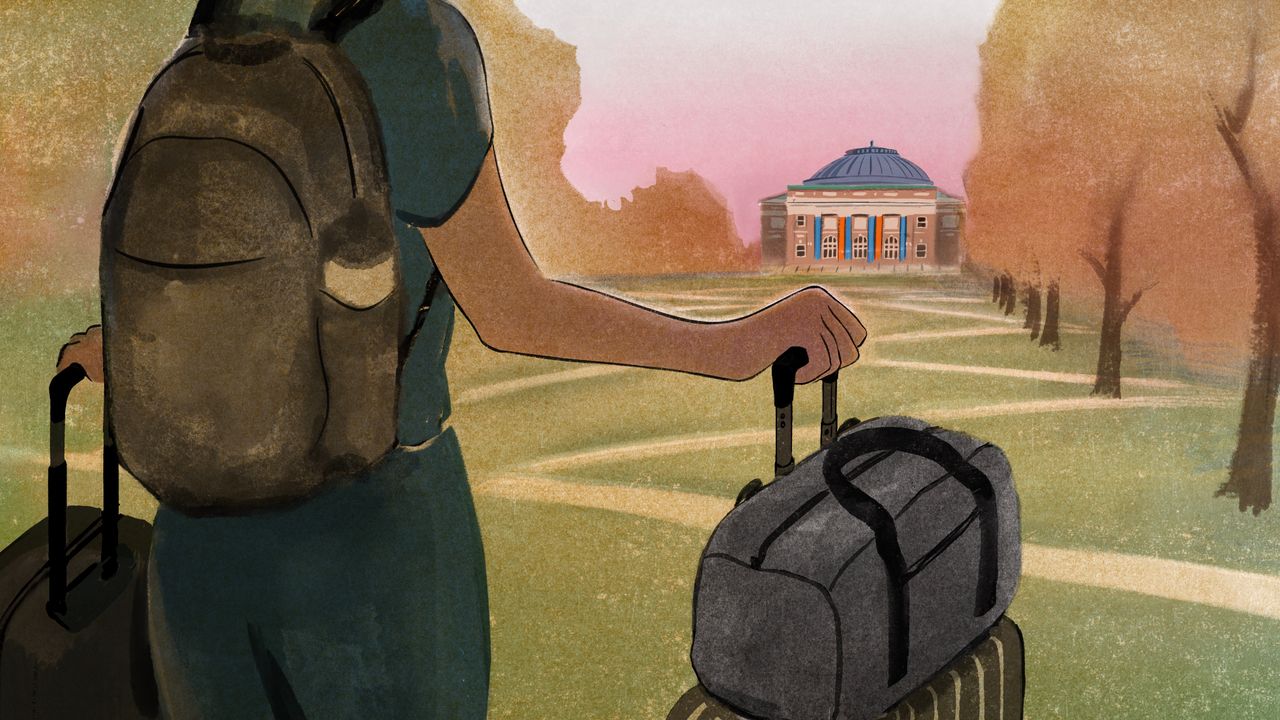
This past February, Steve Cortes, a former Trump campaign adviser, released a documentary segment titled “China’s College Takeover.” It opens with a tractor gliding across a sunlit cornfield. “When you think of central Illinois, in the American heartland, you probably conjure up images of abundant, fertile farms, windswept plains, hearty Midwestern patriots, and perhaps even the University of Illinois Fighting Illini,” Cortes, the documentary’s host, says. “But, unfortunately, you should also picture this.” The film cuts to an Illini football player scoring a touchdown, as a pair of Asian commentators speak excitedly. “Yes,” Cortes goes on. “That’s Illini football, broadcast in Mandarin Chinese—in the middle of America.” International students, he declares, “are displacing American kids, plain and simple.”
The Trump Administration has been hostile toward international students since the beginning of the President’s second term. In mid-2025, the U.S. Department of Homeland Security revoked the legal status of thousands of foreign students, citing criminal-records checks, and tried to suspend entry for international students seeking to attend Harvard. (The Trump Administration said that Harvard had violated the law by failing “to provide sufficient information” about the “known illegal or dangerous activities” of these students.) The Secretary of State, Marco Rubio, announced that the Administration would “aggressively revoke visas for Chinese students, including those with connections to the Chinese Communist Party or studying in critical fields.”
After the release of Cortes’s documentary, the spotlight turned to the University of Illinois. The university system has three campuses: Urbana-Champaign, its flagship; one in Chicago; and another in Springfield. (In 2025, the combined campuses had close to eighteen thousand international students.) In March, the House’s China select committee sent a letter to Timothy Killeen, the president of the university system, contending that Chinese students present a “national security challenge.” The document included requests about their tuition sources and the laboratories they work in, and how many of them were studying subjects such as quantum computing and artificial intelligence.
A month later, I met on campus with Racheal Liu, a nineteen-year-old engineering major from Shanghai. She had arrived in Champaign the previous fall. The looming visa restrictions had worried her, but her concerns fell away after orientation week, as she became immersed in campus life. Liu joined Alpha Omega Epsilon, a sorority for aspiring engineers, became an officer in the Chinese Students and Scholars Association, and made the dean’s list at the engineering school. She showed me a video of the fireworks show at a campus welcome ceremony; in another image, Liu, wearing a tangerine Illinois T-shirt, blended into a crowd of other students dressed in the school’s colors.
Liu lives in an apartment with three other students, also from China, on Green Street, the university’s historic main drag. At night, her block springs to life with students en route to Greek events and bars, such as KAMS, where Kendall Jenner once handed out tequila shots. (The legal age to enter bars in Champaign is nineteen, and the university frequently appears on lists of the nation’s top party schools.) Outside her campus organizations, though, Liu’s social life is mostly separate from those of her American peers. She doesn’t go to bars, and she cooks meals at home to save money. She doesn’t own a car, and she rarely ventures beyond campus to the mall or restaurants downtown, or to the racially and economically segregated neighborhoods that surround the university.
When I met with Liu again, this past August, before the start of her second academic year, she was on edge. Since we had last spoken, the Administration had announced that international students would be allowed to stay in the U.S. for a fixed period of no longer than four years, as opposed to for the duration of their status. A group of higher-education organizations and labor unions sued the Administration to stop the limitations; the University of Illinois Urbana-Champaign was one of fifteen schools to submit testimony. The Pentagon had also ordered thirty U.S. universities, including the University of Illinois, to review their ties to a hundred and thirty international research institutions, mostly in China, or risk losing their federal research funding.
It was getting harder for Liu to ignore the news stories. International students account for twenty per cent of the Urbana-Champaign campus enrollment this year, but, among Liu’s peers, interest in the school and in other institutions in the U.S. had been souring for a while. The restrictions “might not change the fact that people want to study abroad,” Liu told me. “But, for the U.S, they won’t choose here.”
I was born and raised in Champaign, and graduated from the University of Illinois, in 2000, when the campus had just thirty-seven undergraduate students from China. My father, an immigrant from Japan, came to town during one of the first waves of Asian arrivals, in the nineteen-seventies. I remember him buying furikake and nori at the lone Asian grocery store, AM-KO. Now Urbana-Champaign has multiple international grocers, and an H Mart opened last year. The town has also become, in the past decade, a hub for Chinese cuisine, earning a writeup in the Times, which described restaurants on Green Street serving “spicy bullfrog hot pot in a Sichuanese broth studded with green peppercorns” and “yangrou paomo, a Shaanxi lamb soup.”
The transformation happened quickly. As middle and high schools in China rapidly expanded their international programs, the University of Illinois climbed the U.S. News & World Report’s national rankings, and, for many Chinese students it went from being a backup school to their first choice. By 2012, the Urbana-Champaign campus enrolled more than eight thousand international students—more than any other American public university.
As the Asian population soared, backlash followed. In 2017, reports spread about Chinese Communist Party cell meetings being held in the same campus dormitory where I had resided as a freshman. A year later, Rubio, who was then a senator from Florida, raised questions about the “counterintelligence risk posed to U.S. national security from Chinese students.” Legislators worried about Chinese investment in Illinois farmland. In Champaign, a bus company complained about the university selling out “to the highest foreign bidder,” and used anti-Asian advertising: “You won’t feel like you’re in China when you’re on our buses,” one line read. That same year, fears heightened abroad about sending students to America after Yingying Zhang, a Chinese visiting scholar at the University of Illinois, was kidnapped on the Urbana-Champaign campus and murdered. This past spring, when I visited Zhang’s campus memorial site, near the bus stop where she was last seen alive, I saw that people had left flowers, a stuffed penguin, and a Hello Kitty doll. Although the horrific details of her death had spread across Chinese state-run media at the time, sparking safety concerns about the U.S., those worries were overshadowed by the quality of American schools, and so the students kept coming.
On a recent afternoon, Nancy Chen, a twenty-two-year-old who graduated last spring, stood on Green Street recruiting students to sign up for Hungry Panda, an Asian-food-delivery app. Chen came to Illinois, in 2022, after graduating from the Qibao Dwight High School, in Shanghai. When she first arrived, she found herself alongside thousands of other Chinese students, and the campus felt comfortable. Today, she said, the political hostility has shaded perceptions among students, and many are left feeling that schools “just want the international tuition from us.”
Chen and the other international students I spoke to were well aware that American universities, especially the University of Illinois, have strategically grown their programs and offerings to attract higher-paying international students, in order to shore up their own finances. The steady increase in international students at the university coincided with a steep decline in state investment in Illinois’s public colleges and universities—that figure has dropped forty-six per cent since the year I graduated. Students now shoulder the burden of keeping these schools afloat; in the past twenty-six years, tuition and fees have more than doubled at the state’s public universities. In 2024, Illinois colleges were reportedly the third most expensive in the nation for in-state students, and their rate of increase was more than twice the national average for public universities. Nearly half of Illinois residents now go out of state for college. International students, meanwhile, pay between forty-two thousand dollars and fifty-three thousand dollars a year in tuition and fees—more than double what Illinois residents pay.
The university understood that its dependence on international students opened it up to vulnerabilities. In 2017, it took out a three-year insurance policy from Lloyd’s of London, to cover up to sixty million dollars in tuition that international students paid, in the event that there might be a sudden drop in Chinese-student enrollment. When the pandemic hit, the university “made a successful claim against the policy,” according to a report titled “Illinois’ Chinese Revenue Hedge,” co-written by professors from the colleges of business and engineering. The school received twenty-four million dollars, which filled the budget gap for business and engineering schools in the fiscal year that followed. However, the university was unable to renew the policy, hence the precarious situation that the school finds itself in now.
Over the summer, when the school submitted testimony as part of the lawsuit against the Administration’s proposed rule on international-student time limits, Charles Isbell, Jr., the chancellor of the Urbana-Champaign campus and a vice-president of the University of Illinois system, cited a steep decline in international-student applications (including a fifty-per-cent drop in international graduate-student applications to the Chicago campus alone), and warned of potentially “irreparable harm.” This harm has already manifested at other schools, such as Columbia University, which recently announced that it would pause admissions to the journalism school’s Master of Arts program. (Reuters reported that the decision was influenced by fewer international applicants, who currently make up about half the program.)
In October, the Department of Homeland Security proposed a rule that would introduce a seventy-thousand-dollar fee for F-1 international students applying for Optional Practical Training, which authorizes them to work in the U.S, plus an additional thirty-thousand-dollar fee for any subsequent periods. The University of Illinois estimated the plan would cost the university nearly a hundred and eighty million dollars a year, accelerate declining international student enrollment, constrain academic programs, and hurt the economy. (International students support more than six thousand jobs in the Champaign-Urbana area and contribute around $659.3 million annually.)
On November 17th, a U.S. judge blocked the plan. But the challenges for colleges are far from over. The University of Illinois, much like other higher-education institutions, is also bracing for an enrollment cliff, and the possibility that A.I. will ultimately make college less popular, if not obsolete. This time, though, there is no insurance policy for the school to collect on.
In fall, the Urbana-Champaign campus released its head count, based on the first ten days of classes: 12,913 international tuition-paying students, a number that is 1,254 fewer than the previous year. The campus has experienced a nine-per-cent drop in full-time international student enrollment since 2025, and its international master’s student population is down twenty-three per cent. Yet over-all enrollment in the University of Illinois system reached a hundred and two thousand for the first time, because the university admitted more in-state undergraduates. Cortes, it seemed, got what he wanted: more spots going to American students. But as school officials explained in a letter to the Secretary of Homeland Security, domestic students are unable to close the “financial gap created by reduced international enrollment,” since they “do not pay the same tuition rate as international students.”
The university is still in a better position than smaller colleges elsewhere in the state, many of which serve large populations of lower-income, minority, and rural students. These schools face even more severe deficits, brought on by dwindling enrollment and years of state disinvestment. In Macomb, about a hundred and forty miles west of Champaign, declining revenue at Western Illinois University has significantly undercut the local economy. Many students across the state are taking on more debt or working multiple jobs to cover rising costs, amid budget cuts to the campus services that are meant to support them. Some are forfeiting college altogether. “It is existential,” Robin Steans, the president of Advance Illinois, an organization that advocates for equitable access to education, told me. Steans sat on the state commission charged with reviewing higher-education funding. “We have let this go on far too long. We’ve let it get far too urgent,” she said. “It is not easy to come back from that, but it is necessary.”
This year, Illinois legislators introduced H.B. 1581, a bill that, for the next fifteen years, would add a hundred and thirty-five million dollars in annual state higher-education funding, apportioned to schools based on need, which would help better serve rural and minority populations. Steans, one of the bill’s supporters, told me this could serve as a model for other states nationwide facing similar crises. Of the schools the bill covers, only one does not support it: the University of Illinois, which already receives the biggest share of state funding, and whose share the bill would reduce.
A week after the University of Illinois released its new head count, a federal judge in Boston temporarily blocked the Trump Administration rule that would have limited international students to a fixed four-year stay in the U.S., before throwing it out entirely, on November 16th. “The damage to the higher education system and to the economy of the United States is likely to be catastrophic,” the judge, F. Dennis Saylor IV, wrote. That damage has already been wrought, and it might be impossible to undo. According to a recent survey, at the start of the new school year, there were fifteen per cent fewer international students across campuses in the U.S.—a potential loss of $2.4 billion and thirty-one thousand jobs, according to a study by the NAFSA: Association of International Educators.
Some of this comes down to self-selection. Each year, around two hundred students graduate from Nancy Chen’s alma mater, Qibao Dwight High School, in Shanghai. According to the school’s American principal, Michael Coury, ninety-six per cent of his graduates at one point applied primarily to U.S. universities; during the past couple years, that rate has dropped to seventy or eighty per cent. Last year, sixteen students also applied to colleges in Japan—eight times as many as in 2023. Japan has seen a twenty-one-per-cent rise in international students in the past year. Coury also said that half of his students now apply to universities in Hong Kong, which has become the preferred choice for many families. “That is a tremendous change,” he told me.
The recent midterm elections may offer a measure of hope. For the last two years, Studyportals, which tracks student interest in higher education, has seen a thirty-eight-per-cent decline in international student interest in U.S. degree programs. But, after the midterms, there was an almost immediate forty-per-cent jump in interest. “The challenge now is to turn this interest into applications, appropriate visas and enrolments,” Edwin van Rest, the C.E.O. of Studyportals, said, in a recent press release. Still, two years of hostility cannot be erased by a single election. Before the midterms, I spoke with Gary Lu Fangao, a senior at Qibao Dwight. He’s interested in literature and languages, and he already speaks Chinese, English, Japanese, and a bit of French. Lately, he’d been reading the work of the Japanese author Kenji Miyazawa, and thinking about the character Campanella, from Miyazawa’s “Night on the Galactic Railroad,” while contemplating the writer’s ideas on death and happiness. Fangao said that he would still apply to some American schools, including Ivy League institutions, the University of Illinois Urbana-Champaign, and Williams College. But he was favoring the new UTokyo College of Design, and his parents were leaning toward Japan, too. It’s closer to Shanghai, they told him, more affordable than many American colleges, and doesn’t come with the political baggage that international students face under the Trump Administration. “To be honest,” Fangao said, “they don’t want me to go to the U.S.” ♦
This story was published in partnership with the McGraw Center for Business Journalism at the Craig Newmark Graduate School of Journalism.
来源:纽约客中文网