 讲知识 · 讲经验 · 讲未来
 人人可分享 · 处处是课堂
 科技 · 财经 · 游戏 · 快讯,每日更新
 诚搜315观察网
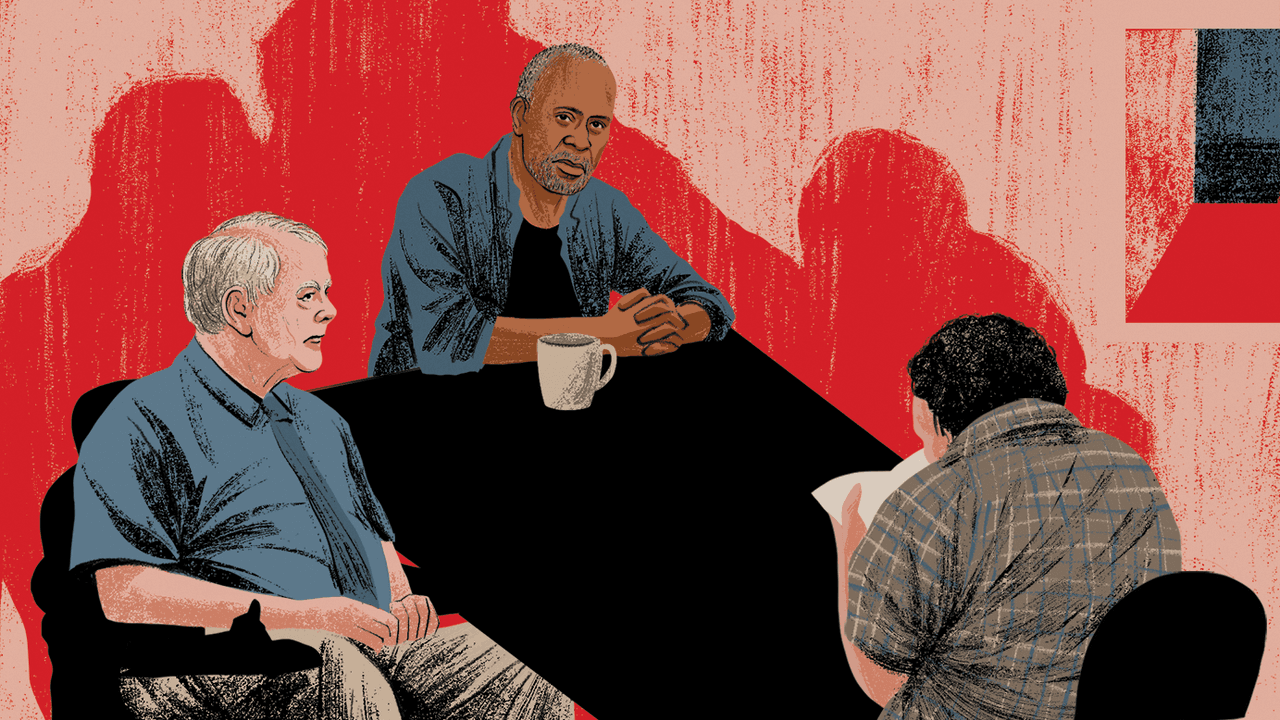
The staggering, morally vexed play “Downstate,” written in acid by the Pulitzer-winning social satirist Bruce Norris, is a tragicomedy set in an Illinois group home populated by four convicted pedophiles, each of whom has served his time in prison. Because they’re listed on a public registry for sex offenders, their lives are hemmed in by a Kafkaesque bureaucracy, consigning them to pariah status. They can’t use the internet or own smartphones. Some scrape by at low-level gigs, such as the graveyard shift in a garage; others subsist on disability benefits. When their shared parole officer (a rock-solid Liza Colón-Zayas, wearing a mask of weary skepticism) stops by, it’s to share the news that, because of a petition from angry neighbors, their perimeter has shrunk further, so that they are no longer allowed to catch a bus to the I.G.A. grocery store to buy food. Once in a while, a stranger fires a gun at their front window.
If this description makes the play, directed by Joe Mantello for its Broadway début, at the Booth Theatre, sound like a bid for empathy, that’s not quite accurate: it’s more of a dizzying moral kaleidoscope, or, perhaps, an optometrist’s exam—one that forces the audience to readjust its vision repeatedly, to the point of discomfort, in an effort to find a sharper way to view this underworld, sunk in banishment and shame. That test begins with the opening scene, a bleakly funny set piece in which one of the men’s victims, Andy (Thomas Sadoski), struggles to read a printed statement to Fred (Francis Guinan)—the Chopin-loving music teacher who molested him—only to be derailed. Fred, who is now an elderly man in an electric wheelchair, has the daffy mien of a retired Santa Claus; although he never denies his crimes, he keeps piping up with offers of coffee and with soft, encouraging “hmm”s, a response that clashes surreally with the fiery accusations he’s absorbing. Andy’s antsy wife, sitting nearby, constantly inserts edits into his statement, and Fred’s roommates stroll in to bicker over bills. As a result, Andy’s manifesto—in which he denounces Fred as “fundamentally evil,” then shares a florid revenge fantasy in which he sticks a gun into his abuser’s mouth—fizzles. It’s a nifty, nasty bit of farce, skillfully engineered to throw the audience off kilter from the start. Whom, exactly, are we laughing at?
We gradually meet Fred’s roommates. There’s Dee (an astonishing K. Todd Freeman, who originated the role when the show premièred, in 2018 in Chicago, at the Steppenwolf Theatre Company), a tart-tongued choreographer who served fifteen years for what he continues to insist was a mutual romance with a fourteen-year-old male dancer. There’s Felix (a tormented, powerful Adrian Martinez), a mostly silent figure who hides out behind an accordion partition that separates his bedroom from the living room; he molested his daughter, back in Texas. And there’s Gio (Al’Jaleel McGhee), a Bible-thumping Target employee who was convicted of statutory rape, but claims that the girl lied about her age. The show is superb when tracing the subtle variations among the housemates—their level of acceptance or defiance, the lens through which they view their crimes (as sickness, as sin, as love, as misunderstanding), their generosity or selfishness toward the men around them. Gio, theoretically the least culpable, is in certain ways the creepiest of the bunch; a homophobic bullshit artist who keeps bringing home a vaping, possibly underage colleague from Target (a funny Ivy Wolk, working her Gen Z shtick), he’s reckless about the legal danger he’s putting his roommates in.
Norris, a Texas-born playwright who originally broke out as an actor at Steppenwolf, is a whiz at crafting sly, prismatic debates in which both participants are deceiving themselves. His specialty is skewering liberal hypocrisy, as in the play that received the Pulitzer, “Clybourne Park,” a damning fable about smug white gentrifiers who buy the house from Lorraine Hansberry’s “A Raisin in the Sun.” Two decades ago, Norris himself dealt with accusations of a niche form of theatrical abuse: in 2005, when Steppenwolf staged the playwright’s rude family lampoon “The Pain and the Itch,” a critic was troubled by the presence of two child actors who, as a key part of the plot, obsessively scratched their crotches onstage. The coverage cast a pall; when Norris nonetheless won an award for the production, he bitingly remarked, in his acceptance speech, “You know, normally when you abuse little girls you do prison time. So this is much better.” There’s another undercurrent to this production of “Downstate”: the involvement of the producer Scott Rudin, who got “cancelled” for bullying his assistants, then staged a comeback, and whose presence feels uneasily resonant with a play that asks—however astringently—whether abusers can be reintegrated into society.
If Norris’s opening scene slaps down a risky bet, the rest of “Downstate” pays it off in spades, by exploring a series of incendiary, seemingly irresolvable questions about what qualifies as justice—or healing, or repentance—without letting anybody off the hook. In the first act’s most bravura sequence, the parole officer confronts the quiet Felix, who has violated the rules by going to the library. It’s a brutal encounter, a slow leak of revelations suggesting that Felix, despite his sad-sack demeanor, can’t really be trusted. But, even as the details of his library visit are revealed, there’s an astonishing moment when Felix pleads with the officer to let him visit his sister, who, he says, is dying of cancer. “She’s like the only person left in the world that don’t”—and here, Martinez’s voice drops, after a wavering, weighted pause—“hate me.” It’s a crushing exchange, capturing the horror of living a life submerged in contempt, only to see a final pinprick of light go out.
In the second act, Andy, the victim, returns to the group home, alone. What ensues is a set of ticklish, agitating polemical clashes, as Norris runs gleefully up the scale of moral hazard, octave by octave. For a long time, Dee, the defiant boy-lover, trolls Andy—who is trying to ignore him—with a set of devil’s-advocate positions, and his prey helplessly takes the bait. Played with a sizzling hauteur by Freeman, Dee comes across, at certain moments, as the playwright’s self-insert. He’s a keen-eyed contrarian who has a reflexive impulse to knock down damp therapeutic truisms about trauma, a pugilist driven to defend his peers against the forces of shame, even if the blows he lands are sometimes low ones, like his sucker-punch riposte to Andy’s claim that seventy-six per cent of offenders were molested themselves: “Your child better lock his door tonight.” Freeman is perfectly balanced by Sadoski, who gives a sensitive, beautifully calibrated portrayal of a troubled man who shifts, unpredictably, from childlike vulnerability to manly self-assertion, sometimes in a single sentence, as he tries to defend himself with the blunt tools he’s been handed by a support group. Their exchanges gave me one of the deepest feelings of dread I’ve experienced in years, perhaps because—as a person who can’t quite resist pushing an argument a little too far, once I’ve convinced myself I am on the side of righteousness—part of me identified with the predator.
When Fred returns to the house after an appointment, we finally get to hear Andy’s uninterrupted account of what happened between them. It’s both devastating and convincing. At one point, Andy’s hand, having very briefly brushed Fred’s shoulder, sags with pain, as if it suddenly weighed a thousand pounds. It’s that agony that radiates so effectively at the center of the play: the unnerving implication is that there are some wounds no amount of pious right-think, therapeutic confrontation, cathartic explanation, or commitment to honesty can heal. The person who broke you can’t fix you.
“Downstate” has its weaknesses. Andy’s wife is a caricature, a finger-wagging Karen with a flashy pocketbook, and her Javert-like character cheapens the otherwise nuanced power dynamics in the play. Similar dynamics are embedded in Norris’s early work: “The Pain and the Itch” features another controlling mommy-bitch, and, as in “Downstate,” there’s a scene in which a poorer victim suggests that a more privileged one might be better off if she just got over it. These tensions are exponentially richer in “Downstate,” but there are moments when you can feel Norris’s thumb on the scale, his fingers tapping in frustration. He loathes bromides about childhood innocence that are used to justify cruel policies; he’s suspicious of credos like “Victims always tell the truth.” I don’t believe that one, either: nobody always tells the truth, and memory is chaotic! But I also found myself disputing some of the icy underpinnings of his vision—and then questioning my own ideas. It probably didn’t help that, the day before I saw “Downstate,” I’d read in the Times the horrifying texts sent among the Cornell fraternity members accused of rape, flooding me with a vigilante impulse—the very feeling that Norris has frequently described, in interviews, as the modern world’s signature failing.
By the final scene, the play’s splintery edges feel less like flaws and more like signifiers of the playwright’s scathing sensibility—Norris’s code—marked like scratches on a prison wall. If I had to pick a single challenging drama about outcasts from this season, I might go for Else Went’s “Degenerates,” another experiment in empathy for pariahs—in her case, for incels—perhaps because that play’s morality felt less muddied by wrath. Luckily, I don’t have to choose. “Downstate,” bristling with ideas and distinguished by its refusal to offer comfort, is easily one of the most powerful plays I’ve seen this year, not despite but because of the fact that it left me wrung out and ready to argue for hours. There’s a place in art for moral uplift—you can find it everywhere these days, both onstage and onscreen. But some days I’d prefer to be haunted. ♦
来源:纽约客中文网