 讲知识 · 讲经验 · 讲未来
 人人可分享 · 处处是课堂
 科技 · 财经 · 游戏 · 快讯,每日更新
 诚搜315观察网
Yourcphone bumber is WRONG
Kindly send it or call me as i told you
for me is better if i see you today.
But before 3 possibly
This was the first e-mail I received from my Italian dentist. We had never spoken before; presumably, I had filled out an online form, or sent an inquiry to her office, in my frenzied attempt to find a dentist while living in Rome. Nonetheless, her e-mail felt like a bolt from the blue, hostile and precipitate. In many ways, it was perfectly characteristic of her style. I look at the message now, and I notice the imperious typos, and the fluid, unpunctuated prose chased by the suddenness of an end-stopped line, the urgency that builds and builds only to melt into the breezy ambiguity of that final word, “possibly.” More than anything, I notice the blame. How often is one accused of simply being wrong, so clearly and with such emphasis?
In the months to come, I would learn much more about this woman, whom I’ll refer to as Rossi, a born mercenary, blown by some errant wind into the world of dentistry. It would take much longer to understand why I found her so compelling. All I knew upon getting her first message was that, for whatever reason, her tone resonated.
I replied. We made an appointment to meet later that day.
I had been living in Rome for several months, working for an affluent family in a poorly defined role. Ostensibly, I was preparing one of their sons for entrance exams, but there was also a sense that I was there to offer something broader: a cultural education, a love of learning. I was in my late twenties, and between lessons, I was working on my first novel. Weeks seemed to pass without my encountering anyone my own age, and I was devastatingly lonely, yet I believed that there was a squinting romance to it all—the writing sessions in Italian bars, the long walks, the wine.
In hindsight, I was quietly cracking up. There were many signs of this, but one area of particular fixation was my mouth. Namely, I was worried that there was something terribly wrong with one of my left molars. This was not wholly unfounded. Certain textures or temperatures would send a shudder through me. The pain was ominous, partly because it was unfamiliar and partly because it seemed to presage something much worse. In my relative isolation, it took on metaphorical dimensions. I was harboring defects, something rotten and deep. It felt like weakness. It felt as if, at any moment, my whole tooth might collapse in on itself, a mess of nerve endings and pulp. I started making anxious calls to friends over Skype.
“Do you think I’ll need a root canal?” I asked.
“How the fuck am I supposed to know?” one responded. “Why don’t you go see a dentist?”
“It can be really hard to sort out medical care when abroad,” I replied. “Things are more . . . scarce.”
“Sean, you’re in Rome,” my friend said. “They have teeth there.”
Occasionally, I brought up my dental woes to my employers, who would answer with baffled shrugs. I suppose I hoped that they would make a booking, or give me a referral, or take some other decisive act. It’s a phenomenon I’ve noticed in other people who work with kids. Professionally assertive, we can be oddly passive in our own lives, as if waiting for someone to intervene. It’s the intervention we want, the act of being helped, rather than the solution itself. We’re hoping that all that care will echo back.
Finally, the pain grew so intense that I was forced to take action. I began sending inquiries to English-speaking practitioners. Rossi was the first and only one to respond.
Her practice was situated in a wealthy neighborhood in the north of the city, on the ground floor of a historic building. Like many businesses in Rome, it felt outside of time; classical paintings adorned the walls. I was greeted by Rossi’s dental assistant, who doubled as the receptionist. She was from Eastern Europe and could negotiate entire conversations without speaking. Yet she managed to convey such warmth in her expressions that you almost didn’t notice. In this sense, she was the polar opposite of her employer.
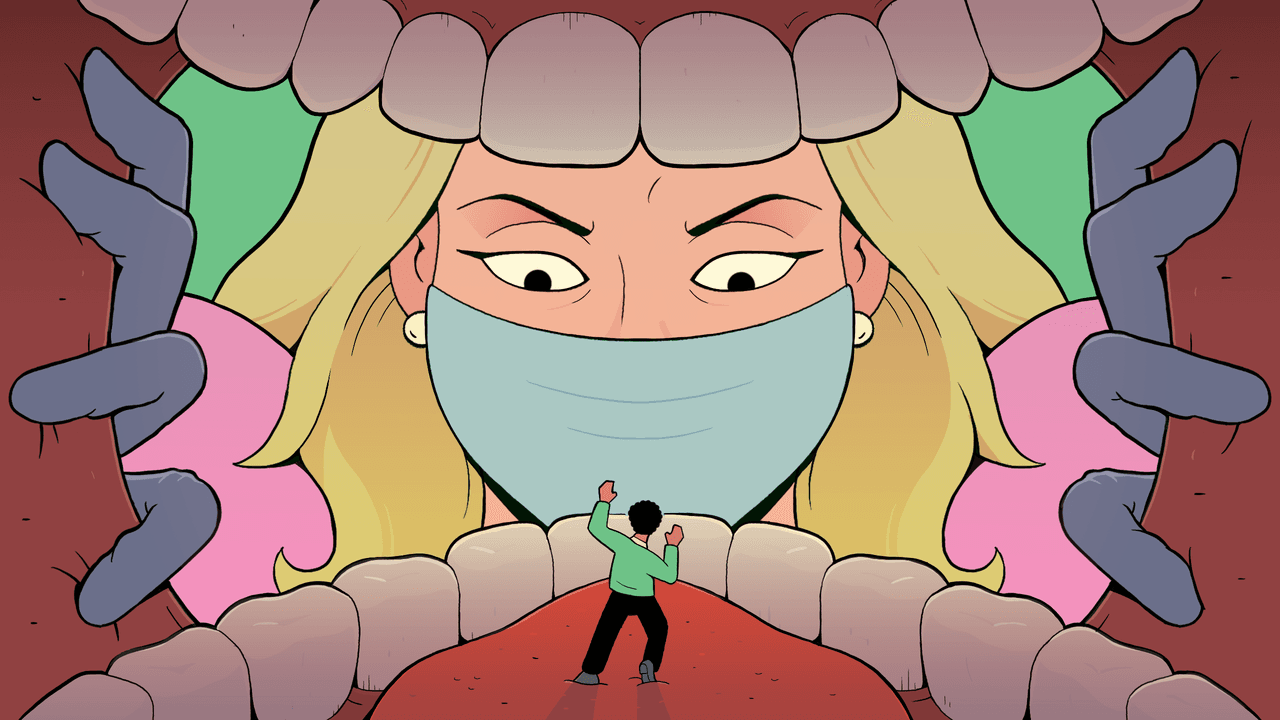
Rossi arrived late—confusing, as she had no prior patients. She wore scrubs, but the utilitarian silhouette and medical fabric could not dull her glamour. She was curvaceous, with glossy hair and a full face of makeup. An image of overflowing femininity, she inhabited herself in a way that was almost punishing. She was such a Madonna figure, so comfortable and so exultant, that you started to wonder if you were, or could ever be, as at ease in your own body.
She bore a cup of green liquid. “I’m starving myself!” she declared. She expounded on the details of a recent juice cleanse, then laughed loudly in a way that startled me. I would notice this over the coming weeks. Her laughter was always difficult to predict: actual jokes might be met with a sour admonishment, whereas the most innocuous details delighted her. It left me with the constant, nagging sense that we were having different conversations.
“Come, come, come, we’re running behind,” she told me, with the subtlest hint that I was the cause of the delay. She ushered me toward a room in the back, pausing in the hallway at another door. “My babies are in there,” she said, coyly. “I hope you don’t mind the noise.” It was perfectly silent. She spoke again, louder, and I sensed that she was deliberately trying to rouse these babies; some sort of bit had not come to fruition. Clearly, she wanted me to play along, but how? Then there was a cacophony of shrill barks.
“Oh,” I said. “You have dogs.”
“Babies!” she corrected. “Would you like to meet?”
We had a brief and obligatory session of patting and playing with five highly skittish, stubby-legged dogs. She was indulgent with them, allowing each to lick her, really getting in there. If I wondered about the hygiene implications, this would be only one of many doubts that I would learn to suppress in this office.
I am an anxious patient: neurotic, desperate for reassurance. Normally, medical practitioners gauge this quickly and adapt, becoming a quelling, gentler presence. Not so with Rossi. She was full of complaints and rancor. I could never seem to open my mouth wide enough, and she would whine and tut as if I were a withholding partner. My tongue was always getting in her way; it infuriated her. While she growled and reprimanded, her assistant serenely drifted in and out of the room.
Before X-rays, Rossi offered a provisional assessment. It seemed like I had more problems than I did teeth. She rattled through a list of obscure issues—a crack or a chip, something about the enamel, bruxism, maybe the gum line could be adjusted. Then, learning that I was diabetic, Rossi piously stated that we would leave the gums intact; she would not undertake such a risky procedure with someone who was immunocompromised.
Details aside, the verdict was clear. “Your mouth is a disaster,” she concluded. My body had never been described in such a way. I had no rebuttal; on some level, I’d known all along.
When we completed the X-rays, we unearthed yet more terrible news. As suspected, there was a gaping cavity in one molar. It was all shadow, all hole. Both Rossi and her assistant were awed by the scale of it, even a little giddy. Evidently, it had been growing for years.
This confused me; I’d visited a dentist not long ago, back home, in England. How had she missed this?
“Sometimes they wait and make the problem worse,” Rossi said, of other dentists. She rubbed her fingers together to illustrate the financial incentive. “You have me now.”
I said that I would write to my old dentist; maybe I should sue. But when I asked for the X-rays as evidence, she grew abruptly circumspect. She could share the image of the cavity, sure, but she would withhold evidence of the other forty-plus problems, in order to keep our powder dry. More importantly, she wanted to know which of the issues I’d like to address.
“All of them,” I said.
“All of them?”
“I want them all fixed. I can’t live like this any longer.”
Her face lit up with profound pleasure. It was infectious. I, too, was inspired, entranced by a vision of strength—all that flawed, soft organic stuff replaced with incorruptible composite and amalgam. We adjourned to the other room.
Witnessing Rossi tally costs was like watching a jazz musician scat. She spoke with incomprehensible speed and brevity, all while jotting down cryptic notes. She stated a cost, the actual cost, then reduced it by some seemingly arbitrary percentage. It was exhilarating. Then she would quote another figure, and claim that it was absolutely nonnegotiable, rebuking me, almost, for even contemplating a haggle. “My hands are tied,” she would say, before pantomiming her bondage.
It would take months, and it would cost thousands of euros, eating into the savings I’d put aside to pursue my master’s degree the following year. No matter. I was all in. Rossi or bust.
I was hurling a six-year-old across a ten-metre pool. He would fly, splash, then paddle back toward me with undiminished enthusiasm. It was a tough workout. The bottom half of my body was submerged in the water, but the sun was piercing that day.
The family I worked for had relocated to their estate in the Italian countryside, where I was given my own basement apartment, next to the wine cellars. After teaching for a few hours, I was allowed to do as I wished, perhaps enjoy an Aperol spritz on the roof, or join the family for a lazy four-course meal, or, like today, mess around in the vast, saltwater pool while music played through the Sonos. During such periods, I would integrate with the family in ways that felt painfully ambiguous. The staff didn’t know how to treat me, whether I was a guest or their colleague. My status was mercurial even to myself.
This was the first time I had truly embedded with a family. I had done teaching stints with other families in Hong Kong, Dubai, and London, though normally I retained my own apartment. It was sometimes unclear why these families hired me. On first impression, I was a little weird and thoroughly unpolished. The agency that sourced these gigs was presided over by a motley gang of posh young women with Shakespearean names. It was an office of Ophelias and Cressidas, and a Rosalind for good measure. They were emphatically, unscrupulously, Yes People, offering prospective clients the world. If you came seeking a math tutor, you might also leave with a personal trainer who specialized in under-thirteens, or a piano teacher for your infant. I tended to be bluntly self-effacing. Often, I told clients that I was the wrong person for the job, or that the job was gratuitous. And yet the more I seemed to demur the more certain families viewed me as a necessity.
Sometimes the relationship simply worked. You could typically tell within the first few minutes. A child responds to one of your asides with unexpected curiosity, or perhaps they make a joke that catches you off guard, or offer an interpretation that unbalances you. This had occurred with the family in Italy. When I met my thirteen-year-old pupil, who I’ll refer to as R., we clicked right away. Both of his parents were titans in their respective industries—big personalities, with controversial opinions, voices that filled the room. Like many kids in that position, R. answered them with a corresponding shyness. He adored them, and he accommodated them, happily ceding the stage to his charismatic mother and father. Our backgrounds were extraordinarily different, but we had a lot in common, and he seemed to sense that. Even though I represented hours of extra homework, and all sorts of things that he didn’t want to do, we instantly became friends.
The job was supposed to last seven weeks, but we kept extending the contract. There was talk of spending Christmas together. There was talk of making this a permanent position, even after R. was sent to boarding school, as he had two younger siblings. It was ridiculous, but for some reason I couldn’t quite decline. So we simply continued, touring the family’s properties, chasing summer.
I had not yet had my root canal, but it played on my mind constantly. I worried that my tooth would burst or abscess before Rossi had a chance to fix me. I worried equally about what it meant to be fixed by Rossi, a woman who appeared unhinged. Sometimes R. asked me about this. He was the only person in the house who was consistently sensitive to other people’s disturbances. I joked that maybe my teeth would fall out. He said that I’d need to buy some new ones. I said that maybe his parents could foot the bill. He didn’t reply to that. All mentions of money made him uncomfortable. Maybe he also sensed that this was a non-starter. Despite everything, this was a business relationship. Even at thirteen, he knew that it was dangerous to hold those sorts of fantasies, to expect too much from the wrong people.
“Sean. I love to say your name. Sean, why are you always so afraid? I think maybe I should be your life coach, to help you. You know what is neurolinguistic programming?”
My second meeting with Rossi took on a philosophical dimension. I could not answer her because my mouth was clamped open. Could I have answered her otherwise? She continued to drill.
The root canal was predictably awful. Rossi didn’t hurt me, exactly, but she did everything in her power to make the experience as surreal and disturbing as possible. It was the opera blasting as she worked; it was the odd, sympathetic silence of her assistant; it was Rossi’s tendency to ask direct questions, knowing that I could not speak, and her irritation whenever I failed to answer. It was the fact that she literally paused, mid-procedure, for a juice break. Then took a modest sip. Then pretended to gag. She explained that she hadn’t eaten for two days, that she was faint, tired, and then neglected to address the obvious follow-up question: Should she be practicing in such a state?
If I indicated pain through the anesthetic, she’d grow huffy, as if I were impugning her work. “Relax,” she said. “It’s your thoughts—that is where is the pain.”
The strange thing is that Rossi was right. More than once, I felt that she had some preternatural sense of me. Her words would linger: Why was I so afraid?
When the session ended, the relief was palpable, narcotic. A part of me wondered if we should light a cigarette. Natural endorphins, unnatural painkillers, hope, exhaustion all blended together in that heady air of release. We had plans to meet the following week. It seemed we had plans to meet virtually every week.
After I left, I bought a scoop of cinnamon gelato. It was ice-cold, and I felt no fear. In fact, I felt like my mouth was constructed of titanium, like I could eat bricks. Of course, at this point, such a thing wouldn’t have been prudent: I had only a temporary crown. But the thought that my cavity had been excised, that the compromising flaw was gone, gave me a sense of invincibility, and I craved more of it.
I had never considered what it would be like to experience an earthquake. What surprised me most was my lack of confusion. I woke up, and my entire room was shaking from left to right. I knew instantly what was happening.
It was a 6.2 earthquake in the region of Lazio, relatively close to where the family and I were staying, at their countryside estate. Outside, the family assembled. The grandparents, who were staying with us at the time, were curiously sanguine. We learned that they had felt the shaking but had misinterpreted the cause: they had assumed that the Rapture was under way. Judging by their expressions, they were enormously content with the status of their souls.
The main house had been damaged. Surveyors were summoned the next morning to assess. However you looked at it, we were lucky, spared the real devastation that was unfolding across the region. The news was dominated by images of levelled homes; even short journeys between villages were now untenable. R. and his younger siblings were spooked, reluctant to sleep in their beds or to go upstairs, where the shaking was more pronounced.
I had sent an accusatory e-mail to my old dentist in London. In her reply, she was professional and careful, but offered her apologies and wanted to make things right. Although she didn’t contest Rossi directly, I sensed that she had reservations about the diagnoses. Unfortunately, I was not yet ready to hear this. Days later, one of my friends was more forthright in her concerns.
“Are you being defrauded by a dentist?” she asked, over a Whatsapp call. “Also, why are you still in Italy? You were supposed to be back months ago.”
I explained that I was building up savings for the next year.
“And blowing it on veneers?”
She didn’t get it. This was a necessity.
“You can save in London,” she told me. “Since when was living in Rome a prerequisite for doing a master’s? I’m, like, concerned about you.”
Quitting the job was unthinkable. I knew that the family didn’t need me, exactly, but I simply couldn’t leave. I had begun conducting some of my lessons at the boy’s school. Often, the mother would drive me there, and as we made our way across the city’s congested roads, the antiquarian marble bridges, she would talk about her life, her doubts. And sometimes, when guests came over and faltered a little, trying to place me, she would say something like, “Oh, well, Sean is basically like one of our sons.” You can’t help but react to such things, the way the body reacts to sudden warmth. My friend’s questions hovered, though. Why was I there? What was I hoping to get?
After my previous session with Rossi, I was buoyed for days, riding sudden eddies of inspiration. I wrote a short story, and it got published. Looking back, it wasn’t very good, but what a thrill, to make things happen, to suddenly act upon the world again. Yet, another part of me truly dreaded returning to Rossi—the intensity of it, the unpredictability. As the next appointment drew close, she was a shadow that stretched ever taller.
The family and I travelled more that summer, even zigzagging across the Atlantic. One day, as Autumn loomed, we were making our way back to Rome, travelling in convoy. One of the younger children was feeling particularly rambunctious, and the nanny was unavailable. Things felt fraught.
I mentioned before that I’m diabetic. I carried a small arsenal of medication with me: two types of insulin, needles, backups, a blood monitor, test strips, a finger pricker, lancets, dextrose tablets. On this occasion, my blood monitor crashed. I was flying blind, and if I didn’t source a replacement before the shops closed (and shops are always on the brink of closing in Italy) then I wouldn’t have readings for an extended period of time. Buying another would involve a small detour, although nothing too onerous.
The mother, who was driving the car I was riding in, seemed unusually put out. R. began researching backup pharmacies, asking me questions to gauge whether I’d become hypoglycemic. It was unnecessary, but touching. The mother repeatedly checked how much time I would need in the shop.
We ended up in a large supermarket. It sold monitors, but all with incompatible strips, and many of the devices used an American unit of measurement that I couldn’t make sense of. I was on borrowed time; the mother began to openly resent me, as if I were deliberating between varieties of Lay’s crisps. I bought a monitor. In the car, I completed a reading but couldn’t understand the results. With patchy 3G internet, R. and I Googled conversion charts until we determined that I was in range. He cheered as if I’d accomplished something. His younger siblings, always following his lead, cheered, too. Their mother remained quiet.
I’m not sure what she was thinking about. Maybe she was picking up on the fact that her son was so instinctively different from her, and she felt a sense of lack. Or maybe she grasped how intimate things had become between us all and wondered how we’d got there. Perhaps she wondered who the fuck this guy was, sitting in her car, with his strange machine and bloody fingers? Why was she risking a late flight for him? What was owed, and to whom?
The tension seemed to persist. Later, driving along another motorway, we passed a copse of burnt olive trees. She mentioned that sometimes the firemen start conflagrations so that they have something to do—to justify their wages, she said.
We put on the radio.
Gradually, the atmosphere in the vehicle thawed. The mother began mentioning a problematic relative who was estranged from another relative. I tentatively suggested that maybe this was good. I alluded to myself, my own family history, avoiding detail, but still speaking with feeling. She cut me off. “Yeah, you know, that’s a terrible thing,” she said. Then she glanced at her kids in the rearview mirror, as if checking that they hadn’t been indoctrinated. We idled in familiar traffic. I felt like the people outside on the streets, drifting past our window, forgotten as they are perceived.
The conversation lingered in my head for a long time. Eventually, the parents were both gone, attending to business in different countries. I remained with a skeleton crew of workers—chef, nanny, cleaners—in the family’s spacious apartment. We goofed around with the kids, I met the nanny’s partner, and the chef produced still delicious, but casual, dinners. He experimented with new recipes, enjoying his craft now that he was free from the onslaught of service. It was like a draft of fresh air. I had always admired the apartment: the elevator opened onto a private entrance; the back wall featured a mural; every room had an en-suite, with Molton Brown toiletries, large bathtubs hewn from unfinished marble. And yet all that luxury, all that glamour, now appeared provisional. On some level, I had felt that I had ascended here, like a player in a video game who’s unlocked a certain level. Since the conversation in the car, I realized that these rooms were as far away as they had ever been. One day, not long from now, I would pass this apartment and just be another stranger outside.
When the parents returned, there was renewed talk of me joining them for Christmas. To me, it was suddenly obvious that this was a terrible idea. Equally obvious was the need to curtail my treatments with Rossi.
In our next session, Rossi proposed taking molds for a night guard. She spent the entire time loudly talking on the phone in Italian. She would acknowledge me with a nod or a wink but knew that I couldn’t understand a word. After, she explained that she’d needed to take that call; she was speaking to someone who had lost everything during the quakes. The tenor of the conversation did not correspond with this tragic backstory. I used my irritation as a motivator to confront her. I explained that the subsequent treatments were not necessary; it was time to call it a day.
I did not expect Rossi to take this lying down. She grew combative, arguing that if I suspected that she was exaggerating my needs for her own gain, she was insulted. I explained that I suspected no such thing, though, of course, her sheer defensiveness made me wonder. It then occurred to Rossi that this would have immediate bearing on the fee structure. She had priced everything anticipating a certain volume of business. The temporary crown would have to be more expensive. Come to think of it, that previous procedure had been underpriced. By now, I was so exhausted that I simply wanted to capitulate and escape.
And, for a while, I did. I overpaid and left, with no plans to see her again. Weeks later, at the start of December, I insisted upon my first vacation day. My employers seemed confused by the request, but knew better than to challenge it; there was a new adamance about me. I travelled up to Florence and spent the afternoon browsing great art in silence. I took a detour to Arezzo to visit the famous antiques market. Surrounded by acres of eighteenth-century door handles, I realized that I was ravenous for conversation and that all my decisions, up to that point, had been confounding.
For the next few weeks, I dutifully continued writing in cafés and visiting galleries and churches, but the energy had gone, and I felt desperately isolated. So it was a complicated relief one bright, cold afternoon when my tooth fell off. The glue for the temporary crown had come undone, weeks earlier than expected.
I felt an almost Pavlovian panic at the thought of seeing her again. Still, I texted her immediately. Even though it was the weekend, she called me back, within minutes. She began haggling, plucking prices from thin air, cajoling me. For the first time, I lost it. I told her it was unconscionable after all this that she still wanted more money. In my rage, I sounded more like Rossi than I did myself. Surprisingly, she absorbed all of this without rebuttal. She told me to come later that day.
Our final session had a dreamy quality to it. Her assistant was away, and I realized it was the first time that Rossi and I had ever been fully alone. She worked at a languid pace. She told me that the Agenzia delle Entrate, the governmental body responsible for taxes, were unbelievable, predaceous. Their rates were brutal. (Years later, Rossi denied passing judgment on the Italian tax authority. She also denied saying anything about my diabetes, disparaging other dental professionals, and touching her dogs while in clinical uniform.)
She worked herself into a small fury, but then the mood seemed to desert her all at once. She wheeled back in her chair. We were done. We sat there: a moment of quiet finality. Late-afternoon sunlight filtered in through the windows. My mind panned out to the well-heeled neighborhood beyond. A Saturday in Rome was unfolding everywhere around us. What a thing. I imagined the countless tourists and locals and lovers drawn out into those ancient streets, lured by some ephemeral promise. I could feel them all, their plans and hopes, like a dull weight against my chest. Looking at Rossi, I believed that she felt it, too. She always had.
She had explored my mouth with cameras and drills, wiped my blood from her latex gloves, and yet, as we sat there together in silence, several feet apart, we’d never been closer. Rossi leaned back in her chair, exhausted. She was just a woman on a juice cleanse, who, like me, had nowhere else to be.
The next day, I prepared to leave Rome for the holidays. I made plans in London for that very night and, in my haste to escape the city, I went to the wrong airport. I got in a taxi and asked the driver to take me to the other airport as fast as she could. In typical Roman style, she took my words to heart, barrelling down the motorway past the speed limit, as one of the car’s tires made a suspicious thwacking sound that we both decided to ignore.
Once I got to the airport, my phone vibrated with a new text message. It was Rossi.
“Sean soery for yesterday…i am a bit disappointed for a new tax bill of 15.000,00€!”
It was a typical Rossi message. Was she implying that she owed fifteen million, or thousand, or hundred thousand euros? Every option was slightly absurd. Yet there was also something different about this text: she had said sorry. Admittedly, she couldn’t bring herself to fully type the word, but it was as close, I imagined, as she would ever get. Above this, she included an actual photo of her tax form, with her actual tax numbers and address. It seemed so guileless and strangely naïve that she would share this with me, unsolicited. She kept typing.
“Aniway… This eas my gift for you… Merry Christmas.”
Beneath it was a stock image of a Christmas tree. I wasn’t sure what to do with this gift, or if, indeed, a stock photo qualifies as a gift.
Life is full of endings. At this point, I had experienced many—some anticipated, some not, some resolved, others still gnawing at me. Yet all too often, we see endings as an inevitability, rather than a choice we make. I began to type my reply. Because I was not ready to lose her yet. ♦
来源:纽约客中文网