 讲知识 · 讲经验 · 讲未来
 人人可分享 · 处处是课堂
 科技 · 财经 · 游戏 · 快讯,每日更新
 诚搜315观察网
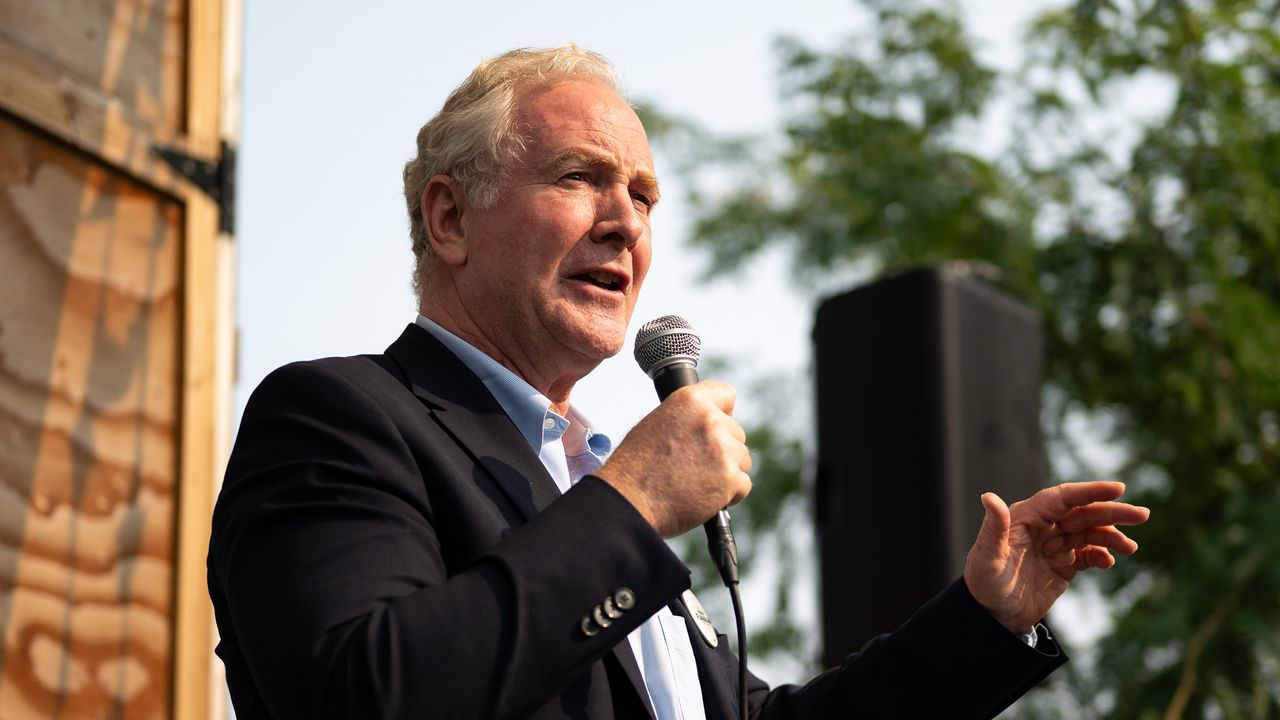
On the Friday before Thanksgiving, the Hart Senate Office Building, with its cantilevered balconies and internal-facing windows, had the deserted feel of an abandoned shopping mall. Senators had cast their final votes of the week, and many of them had fled, hours earlier, into idling S.U.V.s. Senator Chris Van Hollen, Democrat of Maryland, was still in his office, doing interviews and meeting with colleagues before the holiday recess. He’d had “a very busy, active week,” he told me. Eight days earlier, Van Hollen had announced his run for Senate Majority Leader, which, though a long-shot bid, was nevertheless forcing the caucus to consider how to wield its newfound power. “Sometimes I compare this whole race to families getting around the Thanksgiving dinner table to have conversations about politics,” he said. “And, obviously, there are a whole range of opinions among the caucus.”
The job of Senate Majority Leader is a relatively modern invention that, unlike the Speaker of the House, has no constitutional mandate. A precedent dating back to 1937 grants caucus leaders authority over the legislative calendar and which bills reach the floor for a vote. In present-day parlance, “it’s shoving shit through the pipes,” as one Senate Democratic aide put it. “Eating shit” when things go wrong, another said, and “never getting thanked” when they go right.
For the past decade, the Senate Democrats’ chief excrement officer has been Chuck Schumer, the seventy-six-year-old senator from New York, who has ruled his caucus with a flip phone and a flair for flipping seats. Allies credit Schumer for victories this year in North Carolina, Ohio, and Alaska, where his chosen candidates turned longtime Republican strongholds into Democratic territory. During the Biden Administration, he herded a fractious and fragile majority into passing a $1.9-trillion pandemic stimulus package (along party lines) and a trillion-dollar infrastructure bill (with bipartisan support). At least sixteen of Schumer’s colleagues have said they think he’s still up to the task. Schumer thinks so, too. “I’m going to win it,” he recently told the Associated Press.
So far, only six senators have openly backed Van Hollen, who maintains that the “momentum” is on his side. The remaining thirty-one voting senators, meanwhile, have stayed mum. “There’s a lot of active conversation about this, but I think it’s happening one on one,” Tina Smith, a retiring Democratic senator from Minnesota, who supports Van Hollen, told me. “It would not surprise me if you don’t see very many people speaking out publicly about how they’re going to vote.”
In Van Hollen’s telling, his decision to challenge Schumer came as a surprise. He’d spent the past year “kicking the tires on 2028,” as he put it, making trips to early-primary states. “I was quite heartened,” he said of the reception. But the 2026 midterm elections, which delivered Democratic margins unseen since the Watergate era, signalled to Van Hollen not only a repudiation of Donald Trump but also of the current Senate leadership. Nearly half of the thirteen incoming Democratic senators-elect had called for Schumer to step aside on the campaign trail. “The unifying theme is the sense that we need to change the culture of the Senate Democratic caucus,” Van Hollen told me. “That it has been, for way too long, a one-man band.”
Van Hollen, whom the Washington Post once described as “soft-spoken” and “mild-mannered,” is a onetime protégé of former House Speaker Nancy Pelosi—hardly the visage, at first glance, of a change candidate. At sixty-seven, he looks almost indistinguishably senatorial: nearly six feet tall and stocky, with feathered white hair receding at the temples. But, in the past few years, Van Hollen has become an unexpectedly prominent member of the Senate’s progressive wing. He first gained national attention as a critic of the Biden Administration’s approach to Israel. “The bottom line is that the United States became complicit in the devastation of Gaza,” Van Hollen told me. In April, 2025, he travelled to El Salvador to demand the return of Kilmar Ábrego García, a Salvadoran national who had been living in Maryland until the Trump Administration wrongfully deported him. Trump called Van Hollen a “fool” and a “GRANDSTANDER!!!” The Pennsylvania senator John Fetterman, a Democrat, characterized Van Hollen’s efforts as “empty political theatre.” A new generation of left-wing influencers, meanwhile, became fans. Hasan Piker, a progressive live-streamer and commentator, praised Van Hollen last year as “an establishment Democrat doing the right thing for his constituents.”
Van Hollen, who has spent almost a quarter century in Congress—seven terms in the House, two in the Senate—is nothing if not a career politician. Some of his critics dismiss his anti-establishment pivot as a craven play to set up a 2028 bid for President. Van Hollen says that he no longer plans to seek the Presidency and that his decades of experience are a significant factor in why he’s the right man for the Majority Leader job. “We’ve been given this huge opportunity—we have fifty-six votes in the United States Senate,” he told me. “And we better not blow it.”
Van Hollen, who was born in Karachi, in 1959, split his childhood across continents. His father held State Department posts and later served as the U.S. Ambassador to Sri Lanka and the Maldives; his mother’s career included roles with the Office of Strategic Services and the Afghanistan desk at the State Department’s intelligence operation, where she was a lonely voice warning U.S. officials not to back elements of the mujahideen. Van Hollen often tells a story of spotting a portrait of President John F. Kennedy in a remote village in Sri Lanka, hung with gratitude for the Peace Corps’s efforts to dig nearby wells. “We were a country not only known for our military power but the idea that we wanted to help other people,” he told me.
Van Hollen began his political career as an aide to the Maryland senator Charles Mathias, a moderate Republican. Five years later, he won a seat in Maryland’s House of Delegates, the first in a series of victories that would distinguish Van Hollen as something of a ruthless operator. He ascended to the state Senate by primarying a former mentor, Patricia Sher, the Democratic incumbent, who described Van Hollen’s challenge as “like one of my sons has kicked me in the mouth with a boot.” When Van Hollen ran for the U.S. House, in 2002, some of his colleagues saw the move as an act of blind ambition. “Once he decided to run for Congress, I think he lost his compass a little bit,” Barbara Hoffman, a state senator, told the Washington Post at the time.
No matter: Van Hollen beat Mark Shriver, a nephew of John F. Kennedy’s, in the Democratic primary, then ousted the Republican incumbent that November. He rose through the ranks of House leadership as a budget wonk and twice chaired the congressional Democrats’ campaign arm; Pelosi regarded Van Hollen as a possible successor. Instead, he ditched the House for the U.S. Senate in 2016. (Schumer, then the third-ranking Senate Democrat, had backed Van Hollen in the primary.) Some of Van Hollen’s skeptics have questioned whether his run for Senate leadership is an attempt to reclaim what might have been in the House. “With respect to whoever’s pushing this meme out, that’s a bunch of nonsense,” Van Hollen told me. (He says he spoke to Pelosi ahead of his challenge to Schumer, but declined to share specific details of the conversation.)
At the start of the second Trump Administration, Democratic leadership seemed “kind of content to, as James Carville said, ‘play possum’ and wait for Trump to fuck it up himself,” Leah Greenberg, a co-founder of the grassroots group Indivisible, said. Schumer’s decision to join eight of his Democratic colleagues in voting with Republicans to avert a government shutdown, in March, 2025, had especially disappointed the Party’s left flank. Representative Alexandria Ocasio-Cortez, of New York, who is considering a primary run against Schumer in 2028, called his sidestep a “tremendous mistake.”
Van Hollen, meanwhile, seemed eager to shine a light on the Trump Administration’s abuses, casting himself as an avatar of Democratic fury. When Kilmar Ábrego García was deported, Van Hollen sought to meet with the President of El Salvador, Nayib Bukele, while Bukele was in town visiting Trump; Van Hollen didn’t receive a response, so he went down to El Salvador himself. “That was a moment that really inspired a lot of our folks at a time when they were desperately looking for signs of life out of Washington,” Greenberg said.
Van Hollen has also become one of the loudest advocates for placing conditions on U.S. military aid to Israel. “I grew up overseas, and I take seriously the idea that the United States should stand up for its values,” Van Hollen told me. “I think we lose credibility entirely if we do not apply those standards across the board. ” Schumer, who is Jewish and has described a deep connection to the Israeli state, has taken a more restrained approach, backing continued arms support for the country while calling for new elections to replace Israel’s Prime Minister, Benjamin Netanyahu. In 2024, when Netanyahu addressed a joint meeting of Congress, Van Hollen boycotted the event. Schumer, who had joined congressional leaders in inviting Netanyahu, attended but chose not to shake the Prime Minister’s hand. Paul Pinsky, a former colleague of Van Hollen’s in the Maryland legislature, supported Van Hollen’s stance, but also cautioned him that it could be politically risky. “I said, ‘Chris, you’ve got a lot of Jewish folks in your neighborhood in Montgomery County, and I’m sure some people were pissed off when you challenged Schumer and Netanyahu,’ ” Pinsky recalled telling him. Van Hollen was unmoved. “He said, ‘Look, more and more people are going to get tired of this,’ ” Pinsky said. “And he was right.”
The Maryland senator’s clash with Schumer over Israel spilled from policy into politics last September, when Van Hollen, addressing the Polk County Steak Fry, in Iowa, a popular stop for Presidential hopefuls, endorsed Zohran Mamdani’s candidacy for mayor of New York City—and admonished New York’s congressional leaders, Schumer and Hakeem Jeffries, for not yet doing so. (“Chris Van Who?” a spokesperson for Jeffries told the Times in response.) Jeffries would eventually endorse Mamdani, on the day before early voting began, but Schumer never did. “I made the point that there was supposed to be a big-tent party, from [Joe] Manchin in West Virginia to Mamdani,” Van Hollen recalled.
Van Hollen was also dissatisfied with some of Schumer’s preferred Senate candidates, such as Michigan’s Haley Stevens and Minnesota’s Angie Craig, more moderate contenders who represented the views of the Democratic establishment. He and roughly a half-dozen other senators formed what later became known as the “Fight Club” to push back against Schumer’s decision to weigh in on contested primaries. (Nearly two decades earlier, when Van Hollen ran a congressional campaign arm, he had called leadership’s influence on Democratic primaries an “essential part of a successful strategy.” ) Peggy Flanagan and Abdul El-Sayed, the progressive candidates in Minnesota and Michigan, respectively, prevailed over Craig and Stevens on their way to winning their elections in November. Both are now backing Van Hollen’s leadership run. “This is not about opposing Leader Schumer,” El-Sayed told me. “I’ve got a lot of respect for him—extremely pragmatic, works extremely hard, and I really like him, personally. It’s just about where we need to go to meet this moment, and I think that’s going to mean new leadership for a new class.”
Senate Democrats have not had a contested Majority Leader election since 1994, and the current contest has drawn attention well beyond Washington: Jane Fonda, Robert De Niro, and Chelsea Handler are among the celebrities who have endorsed Van Hollen. (“Doesn’t matter—they don’t get a vote in the caucus,” Jim Manley, a former aide to Harry Reid, the late Senate Majority Leader from Nevada, told me.) Senate leadership races are decided by secret ballot; members are not obligated to share how or why they voted. And here’s the thing about overwhelming midterms victories: everyone can tell a story about why their theory of the case was correct. Schumer’s allies have often done so in the form of a sports analogy. “When the manager takes you to the World Series, you give them another contract,” Senator Ruben Gallego, a Democrat from Arizona, said. The Virginia senator Tim Kaine, who has kept his choice private, told me, “Chuck delivered an amazing win. Chuck knows Trump, and that’ll be really, really important going forward.” At the same time, “the voters are demanding change.”
Fetterman, the Pennsylvania senator, has threatened to leave the Democratic caucus if Van Hollen wins. “It would be troubling if my caucus elects someone like Van Hollen, that has really made his name being very anti—hostile to Israel,” Fetterman said in a recent Fox News appearance. But the debate hasn’t fallen along tidy ideological lines. Elissa Slotkin, a moderate Democrat from Michigan, has endorsed Van Hollen. In a video announcement, she said nothing of his politics; instead, she emphasized a need for change: “The American public wants a new generation, and they want big and bold ideas.”
Both Schumer and Van Hollen have pitched finding meaningful roles for the new class of Democratic senators. Both have expressed support for reforming Senate procedure to fast-track popular legislation and help newer lawmakers score quick wins. Even elevating fresh faces, however, will not change the fact that the Majority Leader will remain the most visible member of the Senate and, in turn, the Party ahead of the 2028 Presidential election. “In this day and age, it’s important that the Majority Leader be able to communicate our position to the American people,” Van Hollen told me. For him, that means someone who is “welcome in every part of the country”—a knock on Schumer’s abysmal approval rating—and who uses modern communication tools. “I have an iPhone,” Van Hollen said. “I have both Claude and ChatGPT on my phone.”
Van Hollen had met with Schumer after the election to discuss his frustrations with how the caucus was run and what he thought needed to change. “I’d be bullshitting you if I left here with you thinking I may not run,” he’d told Schumer, “because I am actively considering running.” Not that Schumer could have said anything to dissuade him. “My view, from the beginning, is that we need a change in leadership,” Van Hollen told me. “I wasn’t going in there as a part of a negotiation.” ♦
来源:纽约客中文网