 讲知识 · 讲经验 · 讲未来
 人人可分享 · 处处是课堂
 科技 · 财经 · 游戏 · 快讯,每日更新
 诚搜315观察网
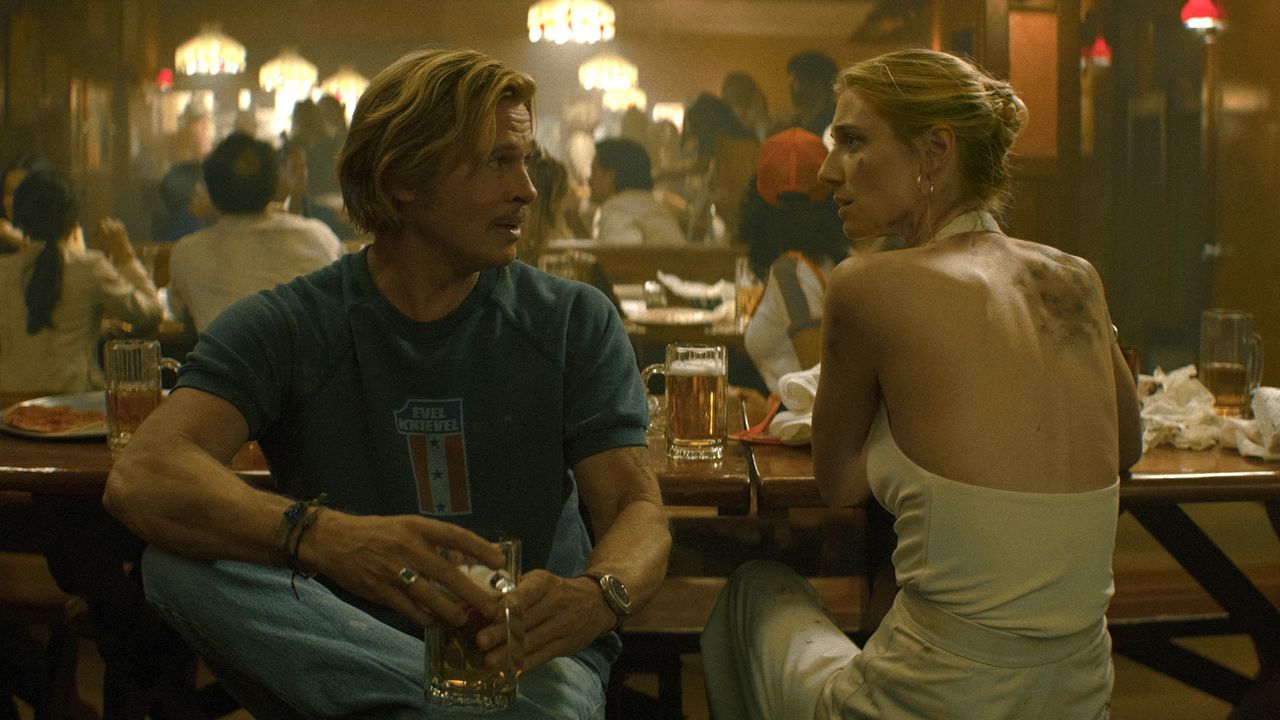
In a way, the most engrossing thing about “The Further Mis-Adventures of Cliff Booth” is what it isn’t: a film directed by Quentin Tarantino. It’s a sequel to his 2019 movie “Once Upon a Time . . . in Hollywood,” which he both wrote and directed. For the new film, he wrote the script but farmed its direction out to David Fincher, and I found myself watching the movie psychodramatically, with an eye for the aversions it may have aroused in Tarantino, the symptoms it may have triggered. To some extent, the movie encourages this kind of diagnostic viewing, because for all its enticements—starting with the cast, led by Brad Pitt and Elizabeth Debicki—it’s a movie of cinematic riffs and asides that calls attention to its artifices and, especially, to its personalized artistic quirks and obsessions.
“The Further Mis-Adventures” is centered on the earlier movie’s main supporting character, Cliff (played by Brad Pitt). In “Once Upon a Time . . . ,” set in 1969, he’s the stunt double for an actor named Rick Dalton (Leonardo DiCaprio), whose career is in a downturn. The new film picks up with Cliff, again played by Pitt, in June of 1977; Rick has departed for Australia, and Cliff, at the margins of Hollywood, is a sometime projectionist at the New Beverly Theatre (which, in real life, Tarantino now owns). He also works as a part-time bartender and does favors for friends as something of a fixer. Cliff is first seen doing his technical duty in the projection booth, seeing a scant audience out after the last show, and then welcoming, into the empty theatre, a pair of crooks (played by Karren Karagulian and Corey Fogelmanis), with whom Cliff negotiates the return of a bag of valuables (including an Oscar statuette) that they’ve stolen. Eventually, negotiating no more, he guns one down and makes the other help dispose of the body.
So much for the projecting; it’s the fixing that interests Tarantino. The next day, Cliff is surprised to be summoned to a meeting with a TV actor named Charlie Peters (Scott Caan), because Charlie is both famed for doing his own stunts and too short to use Cliff as a double. The job Charlie has in mind turns out to be offscreen: in a plot with a coincidental similarity to James Gray’s new film, “Paper Tiger,” Charlie has naïvely become involved with gangsters who are threatening his wife, Toni (Carla Gugino), and he wants Cliff to get them out of the jam. Cliff’s first idea, the simplest, is to pay them what they want. His second idea is to, um, negotiate, and it’s clear what that implies. But these gangsters, ruthless and bloodthirsty, promise an altogether more dangerous showdown.
Unfortunately, this tense setup proves more or less to be a live-action MacGuffin. Tarantino’s script dangles a gaudy array of decorative events and tangy characters, florid dialogue and snappy gestures that are more than the movie’s raison d’être—they’re its main matter. Like a Rube Goldberg contraption, the digressive screenplay is devised to do its job as circuitously, as idiosyncratically, and as ornamentally as possible. The narrative adornments are at least clever, and even when they’re hollow, noisy, and vain they’re, above all, symbolic incarnations of a world view.
Compared with Fincher’s other recent films, “The Further Mis-Adventures” must have been a blast to make. “Mank,” his bio-pic of the classic-Hollywood screenwriter Herman J. Mankiewicz, from 2020, had the heavy weight of real history looming over it, testing Fincher’s artistic superego rather than his expressive powers. “The Killer,” his action movie from 2023, buried both its pulp vigor and any connection to the real world in an overcooked dourness. By contrast, “The Further Mis-Adventures” has the typically Tarantinian explosive action and calibrated slow burns, the motormouth dialogue, the whimsical yet logical twists, the humor, and, above all, the light-footed, hearty energy and exuberant glee that Pitt brought to the original role. His reprisal of Cliff comes with even more self-aware snap, because it comes after a run of disappointing parts, including “Babylon” and “F1,” that risked turning his laid-back charm into a routine and a cliché.
In “Once Upon a Time . . . ,” Tarantino’s direction was at its best in catching the character’s verve in casual action, and in “The Further Mis-Adventures” Fincher captures similar moments with joyful wonder—if not with the palpable physicality that Tarantino brought to the job. Whether Cliff is handling reels and keeping an eye on the projector, the screen, the concession stand; dispensing jazzy pours and non-stop patter at the rowdy bar he tends; or taking sure command of stressful situations, he is essentially a boss in workingman’s garb, a big man in circumstances too small for him. Cliff’s commonplace heroism conceals his real heroism, which is hinted at in the wartime actions that he speaks of, and in his enforcer-like battles on his friends’ behalf. He’s a hidden version of the character played by Bradley Cooper in Clint Eastwood’s “American Sniper”: a protector—albeit one who, by contrast, is portrayed as untroubled by guilt, unburdened by responsibility, indeed lacking any inner life or psychology at all.
Why wouldn’t Tarantino want to return to direct his own sequel, and to help Pitt imbue Cliff with his characteristic swing or some new flair? The answer might be that, in recent years, Tarantino’s focus has tilted so drastically toward the gratifications of his own writing that the aesthetic gratifications he once found in the visual side of filmmaking appear to have dissipated. This shift was evident in his methodical filming of “The Hateful Eight,” which treated the screen largely as a proscenium, and even in “Once Upon a Time . . . ,” which provided a podium for the proclamation of his own old-Hollywood nostalgia. In “The Further Mis-Adventures,” Tarantino uses the same premise to put forward a new idea that amounts to a fascinating renunciation of the art of directing—and yet another mode of nostalgia.
Tarantino’s old-Hollywood veneration is centered on people like Cliff, the rugged characters of rich life experience who, without fame or acclaim, give the movie town its soul. The expression of that soul is in their glorious talk, in the stories they tell. Cliff is a formidable raconteur, who even in high-stakes negotiations spins fabulistic yarns in which to entangle his prey. He tells behind-the-scenes tales about actors in movies that his father, Gus (Peter Weller), a pawn-shop owner, watches on TV. He riffs on some of his derring-do as seen in “Once Upon a Time . . . .” He tells stories about sex. “The Further Mis-Adventures” is a story of stories: where they come from, what they’re for, and what they have to do with movies. And what the film reveals, doubtless unawares, is that a story on its own is a narrative that ends too soon and leaves out too much. It’s not enough to film one. (The shibboleth that filmmakers are mere storytellers is meant to keep producers happy.) What turns a story into a finished work is its transformation, its expansion beyond storytelling itself—which is exactly what “The Further Mis-Adventures” is missing.
“The Further Mis-Adventures” is a Tarantino film not despite the fact that he didn’t direct it but because he didn’t direct it: by not directing, he has given us a manifesto of his new artistic perspective. He has effectively become his own showrunner, with Fincher as a hired hand who thus becomes something like the parody of the auteur that Pauline Kael describes in her 1963 anti-auteurist screed “Circles and Squares”: someone who “expresses himself by shoving bits of style up the crevasses of the plots.” Speaking of Kael, there’s a great love story embedded—indeed, smothered—in the crime drama and the sidebar antics of “The Further Mis-Adventures.” The meeting with Charlie, the actor in need of Cliff’s help, is arranged by the actor’s agent, Karen Crosby (played by Elizabeth Debicki). She’s no ordinary agent but an agent with a prior career as a film critic, which was launched, she explains, with Kael’s help. At one of the meetings (which also includes Toni), Karen is coaxed into delivering, for Cliff’s benefit, her signature riff, which, in short, is that Hollywood movies aren’t and can’t be art—that, even in the best cases, a Hollywood film, as she puts it, isn’t Albert Camus’s “The Stranger” and “isn’t even Kerouac” but the artistic equivalent of hamburger—and she mocks critics for considering it art when all they’re doing is comparing Big Macs to Whoppers.
Whether true or not, it’s at least a convenient view for an agent to hold. What matters to the drama, however, isn’t Karen’s view of movies but her view of Cliff, and vice versa. Theirs is exactly the sort of romance that, Cliff says, would be a high-school cliché—the rough-hewn jock and the regal brainiac—and, apparently, neither Tarantino nor Fincher could get past clichés in working it out. Still, it’s there in the movie, as emotional raw material of extraordinary volatility, ready to produce a spectacular romantic conflagration at the slightest spark, and instead left undeveloped, essentially unused. Debicki, bringing commanding elegance and athletic grace to the role, opens a door and offers a glimpse of cinematic possibilities—and, more important, human ones—that both filmmakers at the joystick boyishly shy away from. ♦
来源:纽约客中文网