 讲知识 · 讲经验 · 讲未来
 人人可分享 · 处处是课堂
 科技 · 财经 · 游戏 · 快讯,每日更新
 诚搜315观察网
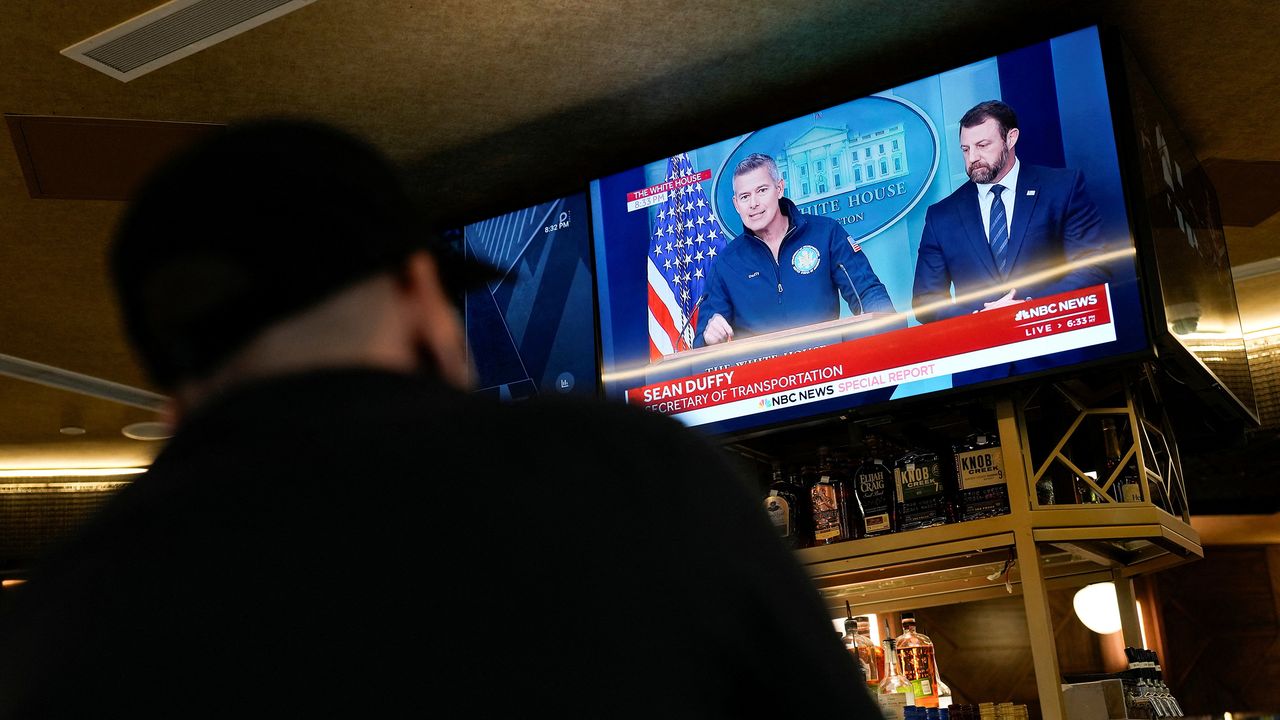
At a press conference on Friday, Sean Duffy, the Secretary of Transportation, tried to explain why the Federal Aviation Administration prevented U.S. flights from taking off for more than four hours on Friday. The internet was quick to speculate that artificial intelligence or cyberattacks were to blame. Duffy’s story, in contrast, was almost comically mundane. He said that the failure happened after a contractor, L3Harris, replaced an old router in the national air-traffic-control system with a more modern one. He also mentioned an ongoing replacement of copper cables with fibre-optic cables. “Our switches, our routers actually got overloaded with data, and they went down. Actually, I shouldn’t say they went down. They started to give us inconsistencies,” Duffy said. The resulting ground stop caused the longest-lasting disruption in nationwide air travel since September 11, 2001. For the four largest airlines, the economic losses could add up to three hundred and forty-five million dollars, according to one estimate.
Duffy, who studied marketing in college before becoming an attorney, does not have a background in planes, computers, or communications systems. Neither does Markwayne Mullin, the Secretary of Homeland Security, who appeared alongside him. Mullin, a former House representative and senator, has a degree in plumbing from Oklahoma State University Institute of Technology. Both Duffy and Mullin were quick to blame Congress, which has been controlled by Republicans since 2023, for failing to fund system-wide upgrades to the air-traffic-control system. Duffy then asked for fifty billion dollars for the Federal Aviation Administration, up from thirty billion dollars that the Trump Administration had requested previously. “I’m going to say it a million times,” Duffy said. “Congress has to give the resources to the President so he can finish this build.”
To understand whether a router could down the air-control system, one needs some context. The F.A.A. has about eleven thousand certified air-traffic controllers who work at hundreds of airports and dozens of radar-control centers. They constantly receive information directly from cockpits, and from hundreds of radar installations, which either bounce electromagnetic waves off planes or communicate with beacons in the belly of aircraft. As a flight moves across the country, it passes from one air-traffic-control sector to another, meaning that a controller has to hand it off to a colleague in the next sector.
With thousands of planes in the air at any hour of the day, and about thirty-five hundred flying at the time of Friday’s ground stop, the system has to be highly automated. One controller might click on a screen to initiate a handoff, and the next controller will click a screen to accept it. Then a lot of critical data—the identity of the flight, its altitude, and its airspeed—is transferred from the first controller to the second. Oral communication, over radio circuits, also has to be routed. It’s fairly common for fumbled handoffs to cause problems; if controllers don’t have reliable information about where each airplane is, or have trouble talking to crews, they have difficulty insuring that each airplane keeps its distance from every other.
This is where the routers come in. At the press conference, Duffy mentioned problems with communications at Air Route Traffic Control Centers, or A.R.T.C.C.s, which generally oversee high-altitude, long-distance flights. Airliners take off under the supervision of a tower controller, who then transfers the flight to a mid-level facility called a Terminal Radar Approach Control, or TRACON. From there, jurisdiction goes to one of the twenty A.R.T.C.C.s that cover the Lower Forty-eight states. Each transfer depends on a computer network that relies on routers communicating seamlessly. A controller would struggle to do her job if she stopped receiving consistent data and voice communication from flights; the fix is to stop adding planes to the system, through a ground stop.
As a reporter who covered aviation for twenty years, I found Duffy’s explanation to be plausible. If a glitch interferes with flight data, then it is prudent to prevent additional flights from taking off. (One question for the agency is why new equipment was being installed during a relatively busy travel period, without the option of reverting to the legacy equipment.) Unfortunately, we should expect such disruptions to happen again. The air-traffic-control system is often described as “aging.” Nick Daniels, the head of the National Air Traffic Controllers Association, the union for U.S. controllers, told NPR that “some of the equipment, when I go into the towers, is older than I am. And I’m only forty-eight.” Updating our aviation infrastructure is not optional; what we don’t modernize will eventually break. Of course, as we learned on Friday, sometimes the cure for aging infrastructure is worse than the disease.
The rest of the Trump Administration’s story, however, is implausible at best. Trump is the first President to have owned an airline, the Trump Shuttle, which operated from 1989 to 1992, and he is clearly fascinated by jetliners. He has claimed that the entire air-traffic-control system needs to be replaced in one go, and he blamed the Biden Administration for its current difficulties. “Everything they touched turned bad,” he wrote on Truth Social. “Big money spent unwisely, making an old and broken system worse than when they began.” Duffy blamed decades of underinvestment across many Presidential Administrations.
In fact, the air-traffic-control system has been a work in progress since its creation, in 1958, after a horrific midair collision in Grand Canyon National Park, in Arizona. It will probably always be one. When I started covering aviation, the Clinton Administration was promising to modernize the system; in 1994, at what was then Washington National Airport, the Transportation Secretary, Federico Peña, held up an old vacuum tube. Vice-President Al Gore, who was there, too, said that the tubes had come from active air-traffic-control infrastructure, and that they were so old that only former Communist countries still made them. Our infrastructure was aging even then.
The Trump Administration did not do the F.A.A. any favors when its Department of Government Efficiency hastily ordered cuts, in 2025, prompting hundreds of employees to retire or resign. About four hundred probationary employees at the F.A.A. were fired, although a hundred and thirty-two were later reinstated by a court. Some of the lost workers supported air-traffic control. A more significant change, however, is that in-house technician work has gradually been outsourced to contractors. After the ground stop, the union representing those technicians, Professional Aviation Safety Specialists, or PASS, issued a statement: “Historically contractors have followed a protocol where FAA employees conduct a risk assessment and coordinate the maintenance of the system or equipment. PASS-represented technicians were not involved in the upgrades that led to the ground stop.”
Perhaps the most unusual thing about Friday’s ground stop was its scale. Over the years, numerous smaller failures have been caused by technicians inadvertently cutting live communications cables while trying to install new equipment. In the mid-nineties, during upgrades to power supplies, F.A.A. radar-control centers suffered ten major power failures in quick succession. The agency blamed seven of them on personnel operating the new equipment improperly. Changes in aviation also introduce new challenges. It’s more difficult to control air traffic under the hub-and-spoke airport model, in which airlines centralize their flights in a small number of major airports. This method gained popularity among U.S. carriers after the deregulation of the air industry, in the nineteen-seventies.
Then there is the Trump Administration’s demand for fifty billion dollars. Over the coming decades, virtually all of the electronic equipment in the system will be replaced. Still, there are limits to how fast the F.A.A. can absorb the money. Under Trump’s One Big Beautiful Bill Act, which passed in 2025, the agency received twelve and a half billion dollars, but so far it has spent very little of it. This should not surprise us. The air-traffic-control system is spread out over millions of square miles, and it is not replaced in one go as an airplane would be. Components tend to be upgraded one at a time, so that if a part fails or turns out to be incompatible, it can be fixed. We’ve also known for a long time that the F.A.A. is short on air-traffic controllers—but hiring more of them temporarily worsens the shortage, because it means diverting a fully certified controller from day-to-day air-traffic control to training. (It doesn’t help that the federal government is operating without a budget, under a continuing resolution that expires on December 11th, which prevents agencies from pursuing ambitious modernization projects.)
Lots of big, complicated systems suffer from component failures. Storms, demand spikes, and aging infrastructure can cause localized blackouts in the electric grid. But air traffic is more vulnerable, because its ripple effects can be so extensive. A plane that waits on the ground for an hour, or four, delays not only its passengers and its cargo but also the passengers who were supposed to board for its next leg. Flight crews can work only so many hours before they “time out,” so after four hours there may not be anybody on hand to fly or staff the original flight. In late September, after damage to a communications cable near a rail line in New Jersey, nine hundred flights were cancelled; another five thousand were delayed. This time, more than eighteen thousand flights were cancelled, and more than twenty-eight thousand were delayed. Days later, flights were still running late. ♦
来源:纽约客中文网