 讲知识 · 讲经验 · 讲未来
 人人可分享 · 处处是课堂
 科技 · 财经 · 游戏 · 快讯,每日更新
 诚搜315观察网
In the archetypal myth of American independent filmmaking, a young person scrapes together money from friends, family, grants, and maxed-out credit cards to make a scrappy but passionate movie. Its première at a major film festival is hailed by critics, and it’s acquired for theatrical release. The filmmaker gets a studio deal for a higher-budget film and soon becomes famous. That’s more or less how such figures as Spike Lee and Richard Linklater got their start back in the day—and, more recently, Ava DuVernay and Ryan Coogler. Careers were launched, and the art of cinema advanced.
Lately, there’s been a lot of anxiety in the film industry that this model is breaking down. At Sundance, long seen as the prime launchpad for independent film, sales have been slowing in recent years, as Hollywood negotiates the challenges of streaming, TV, and other media distractions. And festivals that have long showcased bold outsiders are increasingly dominated by films that, though independent in the technical sense of not being studio products, are nonetheless made with big stars and substantial budgets, even by well-known directors.
Yet the myth of how American independent filmmakers break into the business has always masked a troubling reality, which is that the system failed some of the best work. Even in more robust times, plenty of truly great movies went all but unseen, leaving directorial careers of stunning potential cut off almost as soon as they had started. Entire swaths of cinematic history were thus foreclosed in advance. I’ve come to consider these missing movies and overlooked filmmakers as a shadow history of independent cinema—one that is every bit as important as the official one.
It’s emblematic of the problem that one of last year’s most acclaimed films, Mary Bronstein’s “If I Had Legs I’d Kick You,” would, to most moviegoers, have seemed like a début. It wasn’t—but her actual first feature, “Yeast,” which premièred in 2008, at SXSW, never had a theatrical release. A group portrait of female frenemies in hipster Brooklyn, it stars Greta Gerwig in one of her boldest and freest performances, but it was released solely as a video download, and for years it could be seen only at a few one-off showings. And, for nearly two decades, Bronstein couldn’t get backing for a follow-up. The fact that she was eventually able to film “If I Had Legs I’d Kick You” makes her a welcome exception to the pattern of great female independent directors who never get a second chance. The film’s star, Rose Byrne, got an Oscar nomination for her ferocious portrayal of a mother in extremis; one can only wonder what stories and performances the world missed in Bronstein’s long absence.
In February, 1957, John Cassavetes, a young actor who had been making his name in hard-edged Hollywood movies and on television, appeared on a late-night talk-radio show and, on the pretext of publicizing a new movie in which he starred, asserted that he could make a better one himself (a project that he also publicized in a Times interview) and exhorted listeners to send money that would enable him to do so. The resulting film, “Shadows,” won a prize at the 1960 Venice Film Festival and got a distribution deal, and Paramount hired Cassavetes to direct the jazz-centered drama “Too Late Blues.” The sixties were a financially difficult time for the studios, and they increasingly took chances on new filmmakers, effectively establishing the kind of symbiosis between studio and independent production that persists today. Beneficiaries included Martin Scorsese, whose début, “Who’s That Knocking at My Door?,” won festival acclaim in 1967, and Melvin Van Peebles, whose first feature, “The Story of a Three-Day Pass,” premièred in the same year.
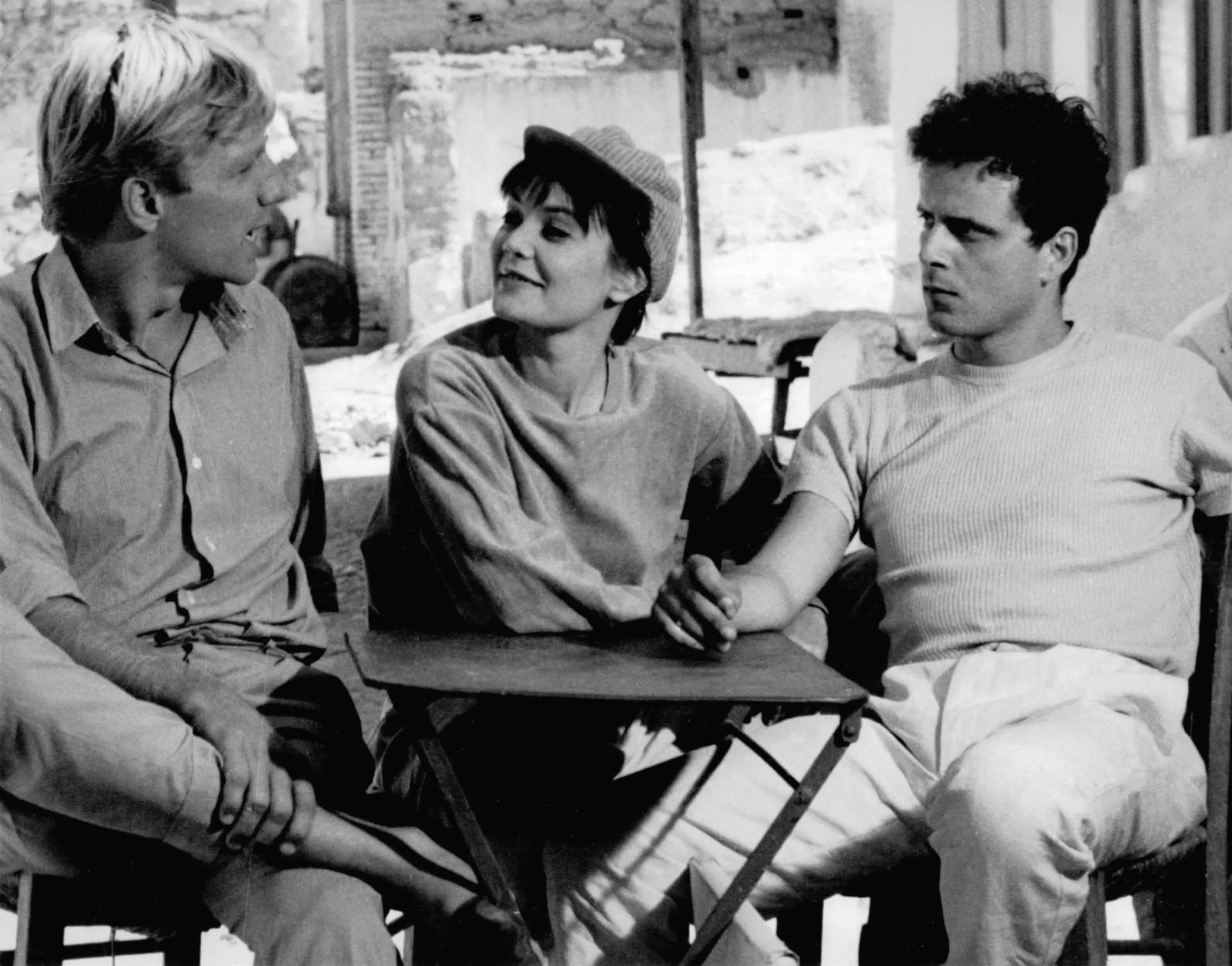
But another spectacular independent début of the decade—Juleen Compton’s “Stranded,” which premièred in 1965 and is fully the equal of the films by Scorsese and Van Peebles—met a sharply different fate. Compton, born in 1933, had acted on Broadway and founded a downtown theatre. She also had a lucrative real-estate career, enabling her to self-finance her first film, which she shot in France (she had connections to the New Wave scene) and in Greece. “Stranded” is a quasi-autobiographical romp starring Compton as an American woman travelling through Europe in pursuit of adventure and experience, sexual and otherwise. Compton had planned to hire someone else to direct, but, as she recalled, Jean-Luc Godard told her, “Since it’s all about you, why not do it yourself?” Her film is as freewheeling as its protagonist, an unhinged mix of melodrama and musical comedy that often breaks the fourth wall in the manner of her French contemporaries. Compton’s inventive direction lent her onscreen presence the whimsy of Audrey Hepburn, the brashness of Jean Seberg, and the self-aware deftness of silent-comedy stars.
The film premièred at Cannes; Cahiers du Cinéma hailed it as the “best American independent film” and Compton as one of the two best female directors in the world (along with Agnès Varda). Yet “Stranded,” though released in France, went undistributed and wasn’t seen again for decades. Compton returned to the U.S. and, in 1966, made another self-financed feature, “The Plastic Dome of Norma Jean.” An allegorical fantasy of a teen clairvoyant whose musician boyfriend exploits her powers, it played at Cannes and other festivals but was released—belatedly and scantly—in 1974. By then, Compton was in Hollywood, confronting male executives’ condescension in a vain quest to obtain studio backing. “Stranded” didn’t surface until 2017, when it was programmed at the New York art-house theatre Metrograph. Compton, who was then in her eighties, attended both screenings, merely as a spectator.
Great films could fail in various ways. Some got festival débuts but no distribution. Others had nominal theatrical releases and then receded into unavailability. Perhaps most agonizingly, some never got shown at all. One such film, William Greaves’s kaleidoscopically shifting metafiction “Symbiopsychotaxiplasm: Take One,” shot in 1968 and completed in 1971, ended up literally stashed in a closet for decades. Greaves, a Black filmmaker from Harlem, already had a significant documentary career when he made “Symbiopsychotaxiplasm.” The film, shot mostly in Central Park, revolves around a brief scene of a romantic couple in crisis, which Greaves filmed many times using a variety of actors, as if in auditions. He also filmed his own process—the crew at work, his direction of actors, intrusions of passersby—and even included a scene filmed in his absence, of crew members criticizing him. The film’s ever-widening analysis of storytelling created real-life drama alongside the fictional one, presenting a self-questioning collective as a political and artistic ideal.
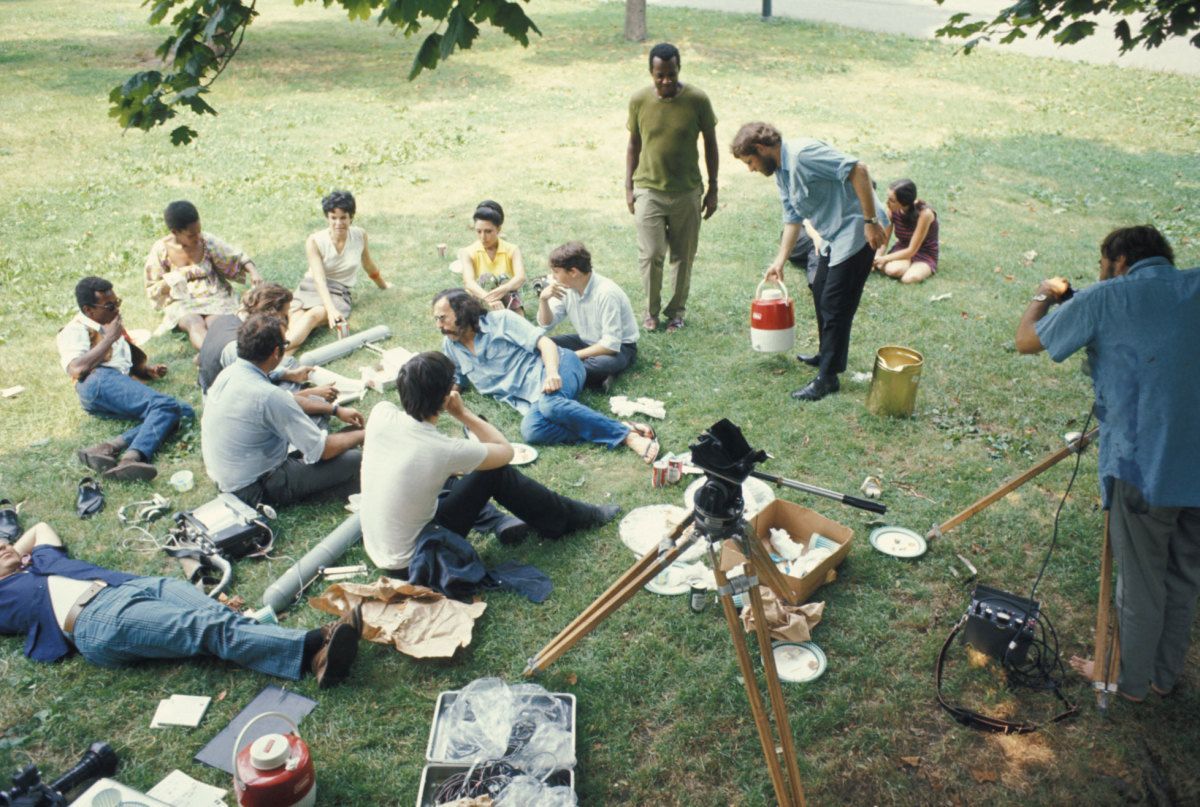
In 1971, Greaves submitted the finished film to Cannes, but it was rejected as incomprehensible. It can’t have helped that, according to Greaves, the projectionist inadvertently showed the reels out of order. But, as avant-garde and metafictional as it may be, it wouldn’t have been out of place at a festival that was showing such works as Miklós Jancsó’s “Red Psalm” and Věra Chytilová’s “Fruit of Paradise.” Back home, Greaves showed his film to distributors. “Their eyeballs went around in their sockets,” he recalled, even though, at the time, complex films by Alain Resnais, Ingmar Bergman, and others were regularly drawing crowds in American art houses. A sympathetic critic at Time told Greaves that the film wouldn’t be “acceptable” for another twenty years. So Greaves put it aside. (It eventually premièred in 1991 and was released in theatres in 2005.) His documentary career continued with some remarkable films (notably “Once Upon a Time in Harlem,” which he shot in 1972 but left unfinished and which, recently completed, was released in October), but he never realized any other fiction projects, so his exemplary blend of social and formal radicalism was lost to several generations. Planned films that the world never got to see include a bio-pic of Paul Robeson, an adaptation of Langston Hughes and Roy DeCarava’s “The Sweet Flypaper of Life” (a fiction and photography book about a Harlem grandmother), and a drama about a female singer and her bodyguard. This last, William Greaves’s son, David, told me, seemed like a precursor to the Whitney Houston vehicle “The Bodyguard.”
By the time that Scorsese and Van Peebles broke into Hollywood, Cassavetes had broken out. Frustrated by producers’ demands, he went back to self-producing, starting with “Faces,” which he shot in 1965, using his earnings from acting, and completed in 1968 by mortgaging the house where he lived with Gena Rowlands, the film’s star and his wife. Cassavetes also encouraged Scorsese on projects of personal importance, and the independent film that resulted, “Mean Streets,” set Scorsese’s career on its definitive path.
Unlike Cassavetes, Scorsese didn’t abandon commercial norms, and the differences in the two directors’ ambitions suggests the bewildering variety of independent films, which can range from, say, Mary Bronstein’s around two-thousand-dollar budget on “Yeast” to the reportedly hundred-million-dollar production of Scorsese’s “Wolf of Wall Street.” Though the more lavish end of the spectrum seems part of the world of studio movies, the independence sought by directors like Scorsese, no less than by ones like Bronstein, involves more than realizing a vision without creative meddling from producers. It also involves working in a production structure of their own creation. Of course, working completely outside the system comes with risks: Hollywood movies that bomb still leave a footprint, whereas independent films can vanish with hardly a trace. This makes programmers, distributors, archivists, historians, and even critics crucial parts of the independent-film ecosystem. It was a curator at the Brooklyn Museum, Dara Meyers-Kingsley, who engineered the première of Greaves’s “Symbiopsychotaxiplasm.” In the case of Kathleen Collins’s “Losing Ground,” from 1982—among the first features directed by a Black woman—it took the combined efforts of a film professor and Collins’s daughter to rescue the work from oblivion.
Collins was a true polymath, a film editor and writer who studied French literature at the Sorbonne, whose activities encompassed drama, poetry, teaching, and civil-rights activism. She began work on “Losing Ground” in 1981, funded largely by grants and by German television. The film, about a philosophy professor’s conflicts with her artist husband, unfolds in a way that’s conceptually elaborate and bruisingly emotional, juxtaposing verbal and erotic tangles in the vein of Éric Rohmer with sensual, vigorous scenes of music and dance. The film was shown once on New York public television and screened at MOMA, but it wasn’t released theatrically and didn’t even play at U.S. festivals. According to Collins, it was rejected by white distributors who found the milieu she’d portrayed—that is, her own—implausible. (She recalled their complaints: “They said, ‘We don’t know any black people like that. We don’t know any black women like that. This is amazing because where’s the racial angle here?’ ”)
Collins died in 1988, of breast cancer, at the age of forty-six, without making another film or seeing “Losing Ground” find an audience. Presciently, though, she made VHS tapes and gave film prints to the University of Indiana’s Black Film Center/Archive and to a few contacts in the Black film community. In the early two-thousands, the film scholar Terri Francis, then a teaching assistant at the University of Chicago, saw one of these copies and immediately loved the movie. For many years after, teaching at Yale, she showed it to her students, until the print she had access to became unavailable. Hoping for a replacement, she reached out to Collins’s daughter, Nina. Nina Lorez Collins had only a videotape but was contacted by the film laboratory where the movie had been processed and told that she needed to reclaim the film’s negatives and other elements—after paying a hefty back-storage fee. She wasn’t sure what to do about these materials, but Francis told her that, when she showed it in class, her Black female students would cry, because they’d never seen women like themselves represented on film. “You cannot let this film die,” she remembers Francis saying. Collins applied for grants, had the film transferred to Blu-ray, and contacted a distributor, Milestone Films, which released it in 2015. Instantly, it was recognized as a nearly lost masterpiece.

Elsewhere, though, studio interest in independent films was growing, stoked by festival successes of the mid-eighties, such as Jim Jarmusch’s “Stranger Than Paradise,” the Coen brothers’ “Blood Simple,” and Spike Lee’s “She’s Gotta Have It,” and what is now called Sundance—founded in 1978, with Robert Redford’s involvement, as the Utah/U.S. Film Festival—emerged as the prime gateway between the independent world and Hollywood. In 1989, Steven Soderbergh’s first feature, “Sex, Lies and Videotape,” premièred there and sold for more than a million dollars, to Miramax. It went on to win the top prize at Cannes, the Palme d’Or, and took in thirty-six million dollars at the box office. In the nineteen-nineties, the pipeline to the mainstream opened wider still: Quentin Tarantino’s “Reservoir Dogs” and Kevin Smith’s “Clerks” became cultural events, and the bosses of Miramax, Harvey and Bob Weinstein, became kingmakers, enshrining independent filmmaking as Hollywood’s farm system.
The lines between independence and Hollywood blurred to the point of vanishing; the careers of Paul Thomas Anderson, Sofia Coppola, James Gray, Darren Aronofsky, Whit Stillman, Noah Baumbach, David O. Russell, and others were launched with independent films. But this new trend had an obvious demographic failing—a dearth of female and Black filmmakers. In 1989, the Italian-born, California-raised filmmaker Rachel Amodeo started shooting “What About Me”—a lyrical yet agonized story about a free-spirited young woman (played by Amodeo) facing harsh realities in the gentrifying East Village. She filmed whenever her cast members—including Richard Edson, who had starred in “Stranger Than Paradise,” and Dee Dee Ramone—were available, and completed it in 1993. It’s the most encompassing and aesthetically refined rendering of the downtown world I’ve seen, but to this day it’s unreleased, its fervent following sustained by occasional special screenings. Amodeo hasn’t yet made another feature.
Even for films that went to Sundance, a successful première was no guarantee of a place in the industry. Wendell B. Harris, Jr.,’s furiously original comedy “Chameleon Street” won Sundance’s Dramatic Grand Jury Prize in 1990. It’s based on a real-life imposter, Douglas Street, a Black man, whom Harris portrays as a vainglorious intellectual stuck in a workaday job. The story’s high-stakes antics are apostrophized by Street’s sardonic grandiloquence and pressurized by ordinary racism. His escape hatch is impersonation—most daringly, of a surgeon at a hospital, where he performs a successful operation—but he’s ultimately forced to go on the run. Despite the Sundance award, Harris received no offer of distribution or financing; Warner Bros. bought remake rights from him, for a quarter of a million dollars. Then Harris spent three years in Hollywood seeking funding for other movies, including one called “Negropolis,” set in ancient Rome. The success of Spike Lee’s “She’s Gotta Have It” (1986) had opened the door for other Black filmmakers, such as John Singleton, Ernest Dickerson, and Warrington and Reginald Hudlin, but not for Harris. “There was a joke going around Hollywood that to make a film you only had to be Black, male, and not Wendell Harris,” he later recalled. “Chameleon Street” received a limited but acclaimed release in 1991, but Harris hasn’t made a second feature, either.
The pattern was repeated at Sundance in 1991, when Richard Linklater’s career was jump-started by “Slacker” while an even more original film, “Daughters of the Dust,” did no such thing for its director, Julie Dash, a Black woman—even though it won an award there, for cinematography, and, upon its release, did better at the box office. Dash’s film is set in the summer of 1902, in a Gullah family on one of the Sea Islands off the coast of South Carolina and Georgia, where a delegation of relatives from “the mainland” arrives in order to organize the island dwellers’ departure, amid the Great Migration. The teeming and panoramic action is centered on the family’s matriarch, born in the time of slavery, and her great-granddaughter, who is pregnant as a result of rape, and whose yet-unborn daughter is the movie’s narrator. With images of rapturous lyricism, narrative freedom involving flashbacks and imaginings, and a story filled with symbols and rituals, the film is a mythopoetic gathering of the Black past. Yet the Hollywood joke that Harris grimly cited proved all too accurate in Dash’s case: she’s Black and she’s not Wendell Harris, but she’s also not male, and, to this day, it’s her only feature, albeit one that looms large in the film world; in the 2022 Sight & Sound critics’ poll of the best films of all time, it tied for sixtieth place with Barry Jenkins’s “Moonlight” and Federico Fellini’s “La Dolce Vita.”
“Daughters of the Dust” had its origins at U.C.L.A., where Dash, as an M.F.A. student in the seventies and early eighties, was part of a cohort of Black filmmakers definitively dubbed the L.A. Rebellion. The group’s outpouring of creativity was comparable with that of the French New Wave or the Italian neorealists—producing such important films as Charles Burnett’s “Killer of Sheep,” Haile Gerima’s “Bush Mama,” Larry Clark’s “Passing Through,” and Billy Woodberry’s “Bless Their Little Hearts”—with the depressing difference that the U.C.L.A. group found little recognition at the time.

The L.A. Rebellion filmmakers strove to create a new Black cinema; as Burnett put it, they’d “argue day and night over what a Black film was.” Another U.C.L.A. alumna and Rebellion associate, Zeinabu irene Davis, advanced the idea with her 1999 film “Compensation.” A richly textured drama of the lives of two deaf Black women in Chicago, one from around 1910 and the other contemporary, the movie won Davis a directing award at New York’s Independent Feature Project; it played at Sundance, in 2000, and received a rave review from Roger Ebert. Remarkably, the earlier of its stories channels the silent-film era, employing no audible dialogue and including Davis’s own reimagining of a lost silent short, from 1913, by an early Black filmmaker. Davis approached history like a documentarian, reconstituting it with an innovative assemblage of still photos, intercut with dramatic scenes to bring the past vigorously to life. How did industry arbiters respond to this paradigm-shifting effort? During a screening at Sundance, Davis recalled, “in the film’s first fifteen minutes, distributors were running out of the room because I didn’t have any dialogue.” A theatrical release came only in 2025; Davis, too, hasn’t yet made another dramatic feature.
In the twenty-first century, the Sundance film became a genre unto itself—social realism, ranging from earnest to grim, with liberal sympathies. Independence was becoming a marketing strategy, a brand, and the artistic aspect was congealing. But starting in the early two-thousands, a new generation of independent filmmakers coalesced around a new festival, South by Southwest, and a grassroots practice that sparked an aesthetic of its own.
A batch of ultra-low-budget films at the 2005 SXSW festival—including Andrew Bujalski’s “Mutual Appreciation,” Joe Swanberg’s “Kissing on the Mouth,” and “The Puffy Chair,” by Jay and Mark Duplass—were made with friends, family, and the filmmakers themselves acting in stories that probed the connections of performance, image, and identity. The filmmakers’ cinema of community, spontaneity, and youth was jokingly dubbed “mumblecore,” and the name stuck. A spate of such movies soon arose, involving a widening circle of young filmmakers that included Lena Dunham, Josh and Benny Safdie, Greta Gerwig, and even Barry Jenkins, in his début feature, “Medicine for Melancholy.”
In 2007, SXSW screened a mumblecore-proximate masterwork, Ronald Bronstein’s film “Frownland,” a furious Brooklyn tale of a nearly aphasic young door-to-door salesman’s downward spiral. The film’s co-star, Mary Wall, was married to Bronstein and directed “Yeast” under her married name. Unlike Mary, Ronald has directed no second feature; he instead became, in effect, the third Safdie brother, working with Josh and Benny as an actor, screenwriter, editor, and producer. It isn’t only Bronstein’s personal involvement that has contributed to the Safdies’ successes; it’s also the explosive power of “Frownland” itself, which, despite a token release, blew a hole in the cinematic ozone layer through which the Safdies leaped headlong. (Mary Bronstein’s “Yeast” also informed the Safdies—who act in that film.) Few paying customers saw “Frownland,” and Hollywood ignored it, but filmmakers, critics, and programmers embraced it excitedly, and it expanded their taste and their senses of possibility.
The same digital revolution that enabled the making of D.I.Y., mumblecore-type films also helped to disseminate them—and even to monetize them. Filmmakers’ communities got word out to a new online audience, including in the new form of social media; the results were seen in the rapid career advances of many distinctive young filmmakers. Bujalski and Swanberg got to work with bigger budgets and starrier casts, and mumblecore filmmakers were tapped for TV series—Lena Dunham’s “Girls,” Joe Swanberg’s “Easy,” Amy Seimetz’s “The Girlfriend Experience,” Terence Nance’s “Random Acts of Flyness.” Many got DVD and video-on-demand deals, and Netflix picked up some notable low-budget movies for streaming.
Yet it has since become clear that the mumblecore boom was a short-lived bubble rather than the start of a new era of viability. A handful of notable breakthroughs, mainly by Gerwig and the Safdies, masks a drastic downturn in low-budget filmmakers’ fortunes. Filmmakers I’ve spoken with said that even before the COVID pandemic reinforced streaming habits, independent films were struggling for viewership. The director Matthew Porterfield, who got his start with the 2006 feature “Hamilton” (named for a Baltimore neighborhood), had a box-office flop in 2018 with his hauntingly beautiful fourth feature, “Sollers Point” (another Baltimore neighborhood), about a young man’s effort to remake his life after prison. He noted, in 2019, “There’s just so much visual, time-based media out there. So we’re competing with television, web series, video games, apps, the emerging VR experience and also branded content.” Porterfield hasn’t yet made another feature.
The stream from D.I.Y. filmmaking to theatres and to viable careers has become a trickle. One of the most original of recent independent films, Zia Anger’s metafictional, multilayered “My First Film,” from 2024, dramatizes her real-life making, between 2010 and 2012, of a quasi-autobiographical D.I.Y. movie, centered on an abortion, that was never shown publicly. After a slender yet acclaimed theatrical release, “My First Film” became streamable but didn’t give Anger’s career a boost. “Ten years ago, if you got one film made, then you get another film made, then you’d kind of fall into a rhythm, and your budgets would slowly get bigger and you’d slowly make a little bit more money,” she told me. “I don’t see that happening among my peers anymore.” She attributes this to a system of “middlemen” that has grown more corporate and more cautious: “People in the film industry are so afraid of film dying that they have become just really afraid in general.”
Alex Ross Perry has made six acerbic, sharp-edged dramatic features since 2009—two micro-budget ones, and four others, including “Listen Up Philip,” starring Jason Schwartzman and Elisabeth Moss. But their lack of wide distribution weighs heavily on him, he told me: “Nothing has reached a level that it would be worth one week of disrupting my family’s life and putting my paid jobs on hold to make no money, start a process that’s going to be in my life for two or three years and then just watch it limp in front of people, scream for attention in an overcrowded marketplace and then just vanish.” His prime source of income is screenwriting for hire, and he continues to work on music videos and documentaries (including the archival film “Videoheaven” and the self-referential docu-fiction “Pavements”). But his most recent dramatic feature was in 2018, and he told me that he doesn’t have another in the works.
Perry worries about how younger filmmakers will be able to forge a path. “You kind of want to believe that there’s still the twenty-five-year-olds going to make a movie in seven days with their friends on whatever format they can scrounge,” he said. “I’m sure those exist, but does the system support shining a spotlight on any of them?” It’s unusual for movies today to disappear as completely as they used to: social media, including the movie-centric site Letterboxd, make it less likely that a film with a festival première or even a few public screenings will be completely ignored—but, owing to the vagaries of streaming and the decline of physical media, even works discussed enthusiastically may disappear with no way to see them. Two of the most original ultra-low-budget débuts of this century, Porterfield’s “Hamilton” and Josephine Decker’s “Butter on the Latch,” aren’t streaming anywhere in the U.S.
A rising generation of filmmakers is facing an obstacle perhaps even more insidious than those of previous generations: an amorphous digital void. Christopher Makoto Yogi, who made two delicately spiritual, daringly imaginative films about the Japanese American experience in Hawaii—“August at Akiko’s” (2018) and “I Was a Simple Man” (2021)—told me that counting on a low-budget film to find a viewership through streaming is a fallacy: when his films dropped on a leading streaming service, the Criterion Channel, he hired publicists to try to leverage the event, but was informed that viewers “don’t see an online release as something that’s necessarily worth headlining.” Perry likewise thinks that streaming mostly helps high-profile films: “What are you going to watch? The thing you heard about, that many people mentioned, that you kept seeing memes and images of, or something you’ve never heard of?” In a 2023 podcast on the occasion of screenings of “Yeast,” Mary Bronstein lamented that self-distributed films are hardly acknowledged because “there’s so much stuff and there’s so much noise” and that festivals such as SXSW now show “Hollywood movies.” She added, “If I made ‘Yeast’ now, I don’t think it would get into any of these festivals. I don’t think that’s what it is anymore. If I was, like, twenty-five again, I’d be very confused and frustrated.”
One of the new generation’s most original independent filmmakers, Tyler Thomas Taormina, now in his mid-thirties, points out that he and his friends’ expectations weren’t informed by the mini-boom of mumblecore. “The early twenty-tens might be the last moment of independent cinema where making a quality film is a reliable road to recoupment,” he told me, adding that he had no such expectations when he made his first feature, “Ham on Rye” (2019). Still, he had an advantage similar to that of mumblecore filmmakers and the L.A. Rebellion: a sense of belonging. In 2010, Taormina, Carson Lund (who was also his cinematographer), and several other aspiring filmmakers studying at Emerson College founded Omnes Films, which isn’t a production company but a collective. Taormina calls it a “sort of community support system” and described its importance in developing his distinctive, pointillistic handling of narrative: “The community wasn’t just human resources, it was also sort of an emboldening of these instincts that are not at all met by the industry.” The budget of “Ham on Rye” was around thirty thousand dollars; the one for Lund’s début feature, the baseball movie “Eephus,” released in 2025, was about ten times larger; that of Taormina’s 2024 film, “Christmas Eve in Miller’s Point,” somewhat more. Lund is in postproduction on his second feature, and Taormina has three films in the works.
Taormina remains clear-eyed about the challenges but sees them as part of a phenomenon that is bigger than the industry: “So much more of the wealth of the common good has gone to an élite few, and that takes away from a lot of the disposable incomes,” he said. “When things become much more survivalistic, I don’t think people’s first reaction is art. I think it’s actually escape, and I don’t even mean ‘Star Wars’ escapism anymore. I mean like doomscroll escapism.” Lund spoke to me of the industry’s own role in manufacturing distraction: “I think it has a lot to do with the way in which streamers have made media feel more like background entertainment, like second-screen entertainment, something disposable.” Like Anger and Perry, Lund sees the drop-off in ultra-low-budget production in generational terms—of filmmakers getting older and having families: “The budgets have to grow because when the budgets grow, you’re actually able to carve out something for yourself.” But what of a new generation following in their footsteps?
Taormina, for his part, is sanguine about the art. “I’m looking at all the films I’ve watched this year, and all my favorite films are all the ones made by my friends.” To him, this suggests that “independent cinema is undergoing something,” something of importance, even though he knows that these films may never be widely seen. He doesn’t blame the system but the skill set that it requires of filmmakers—“the obsessive ability to land a good festival.” I told him I find it depressing that such films seem doomed to obscurity. “I’m not depressed, in that, to me, it warms my heart to see films that are made that are beautiful,” he said. “And I know that if they’re not seen now, it doesn’t mean they won’t be seen. I know that, I have faith. I have faith that the world can come to a configuration where these films can be celebrated.” Still it’s a bitter irony if a new generation of independent filmmakers, knowing the history of great forebears who endured long-delayed recognition, is nonetheless doomed to repeat it. ♦
来源:纽约客中文网